
Are Recyclable Materials Changing Pharmaceutical Tube Packaging?
Introduction
As sustainability expectations rise across healthcare supply chains, recyclable materials are changing how a Pharmaceutical Tube is designed, sourced, qualified, and evaluated by packaging teams.
For decision-makers, the central question is not whether recyclability matters. It is whether a greener tube can preserve protection, compliance, manufacturing efficiency, and commercial value.
The answer is increasingly yes, but only when material selection follows product risk, barrier requirements, recycling infrastructure, and regulatory obligations rather than broad environmental claims.
This article explains where recyclable pharmaceutical tube packaging creates value, where technical compromises remain, and how companies can make defensible investment decisions.
The Business Case Is Broader Than Plastic Reduction
Recyclable packaging is becoming a procurement and market-access issue, not merely a corporate responsibility initiative. Pharmaceutical buyers increasingly assess environmental performance alongside quality and supply reliability.
Hospitals, retailers, distributors, and multinational brand owners are responding to waste legislation, sustainability reporting expectations, and customer pressure for more responsible packaging formats.
A recyclable Pharmaceutical Tube can support portfolio-level environmental targets by reducing dependence on difficult-to-process multilayer structures and improving material traceability across the supply chain.
However, recyclability alone does not create business value. A tube that causes higher reject rates, shelf-life losses, or filling-line disruption can undermine the intended sustainability gains.
Decision-makers should therefore evaluate packaging through total lifecycle performance. The preferred solution protects the formulation, performs consistently, supports recovery systems, and fits commercial operating requirements.
This broader view changes internal conversations. Packaging teams need input from regulatory, quality, operations, procurement, sustainability, and commercial stakeholders before approving material transitions.
The most successful projects connect environmental objectives to measurable business outcomes, including reduced compliance exposure, improved customer qualification, stable conversion costs, and credible brand positioning.
Why Traditional Pharmaceutical Tubes Are Difficult to Recycle
Many conventional pharmaceutical tubes use several materials because pharmaceutical products demand barriers against oxygen, moisture, light, migration, contamination, and physical damage during transport and use.
Aluminum barrier laminate structures, plastic barrier layers, adhesive systems, printing inks, closures, and shoulder components can each serve essential functional purposes in one package.
These combinations are highly effective at protecting sensitive ointments, gels, creams, and topical medicines. Yet they may be difficult for recycling systems to separate economically.
Recycling performance depends on more than the tube body. Caps, shoulders, decoration, labels, residual contents, and collection behavior influence whether a package enters a viable recovery stream.
A package described as recyclable should therefore be evaluated against actual regional collection and sorting capabilities, rather than only against theoretical material compatibility.
This distinction is important for global pharmaceutical companies. A design that works within one country’s recycling infrastructure may have limited practical recoverability in another market.
Responsible packaging claims require evidence. Businesses should understand the material composition, recycling pathway, local acceptance criteria, testing basis, and any conditions attached to supplier statements.
What Recyclable Tube Designs Are Emerging?
The strongest industry movement is toward simplified structures, particularly tubes designed around a dominant polymer family that recycling systems can identify and process more easily.
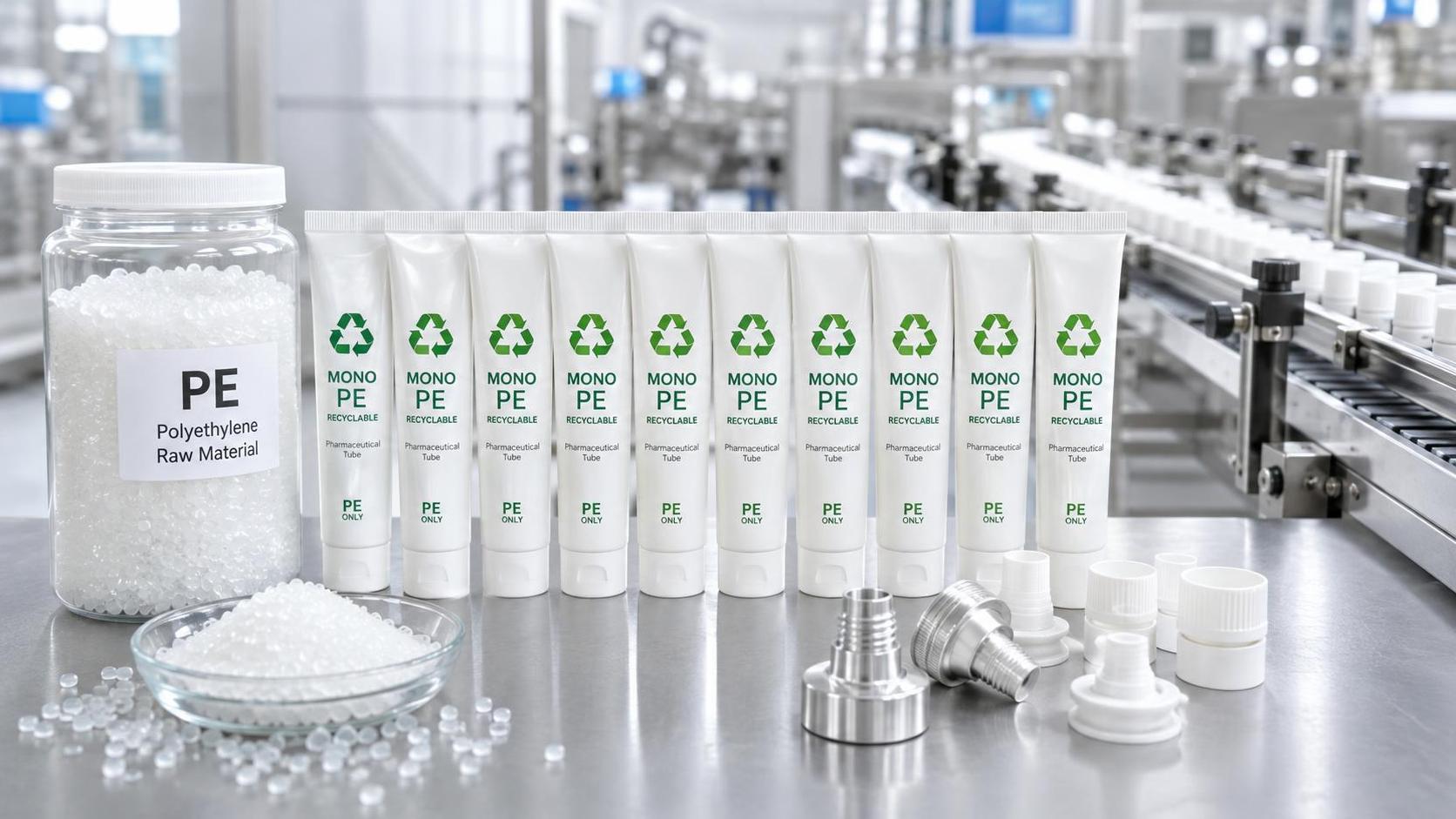
Mono-material or mono-family polyethylene solutions are receiving significant attention because tube bodies, shoulders, and caps can potentially align with established polyolefin recycling streams.
These designs may use high-density polyethylene, low-density polyethylene, or compatible blends depending on the required stiffness, squeezability, appearance, and production process.
For lower-risk formulations, an all-polyethylene structure may provide sufficient protection while reducing material complexity compared with conventional high-barrier laminate packaging.
Some applications require stronger protection than a basic polyolefin tube can provide. In those cases, suppliers may use thin compatible barrier layers or carefully optimized structures.
Material innovation is also improving resin quality, barrier coatings, recyclable masterbatches, and decoration methods that reduce contamination within mechanical recycling processes.
The direction is clear, but no single material solves every application. Recyclable tube design must begin with formulation needs and end with verified end-of-life compatibility.
Barrier Protection Remains the First Technical Gate
Pharmaceutical packaging cannot trade product safety for a more attractive sustainability profile. Any material change must first demonstrate that the medicine remains stable throughout its stated shelf life.
Barrier requirements vary considerably. A simple non-sterile cream has different vulnerabilities from a volatile gel, oxygen-sensitive ointment, medicated toothpaste, or active ingredient with light sensitivity.
Water-vapor transmission, oxygen transmission, aroma retention, solvent resistance, light protection, and chemical compatibility should be assessed before comparing environmental attributes or unit pricing.
Aluminum barrier laminate remains valuable where formulations require exceptional protection. Its high barrier characteristics can be essential for preserving potency, texture, odor, and user experience.
For applications demanding robust barriers, companies may consider ABL Tube‑The Proper Aluminum Laminate Packaging Solution for Pharmaceutical alongside recyclable alternatives during technical assessment.
This is not a contradiction. Sustainability decisions should recognize that extending product shelf life and preventing medicine waste may deliver substantial environmental benefits.
A more recyclable package is not automatically the greener option if inadequate protection increases expired inventory, product returns, patient dissatisfaction, or disposal of valuable pharmaceutical contents.
How Regulatory and Quality Requirements Affect Material Changes
Changing a Pharmaceutical Tube is a controlled packaging change, not a straightforward purchasing substitution. The material may interact with product registration, specifications, validation records, and supplier approvals.
Regulatory expectations differ by market and product category. Companies must determine whether proposed changes require notifications, stability studies, extractables assessments, or formal variation submissions.
Quality teams should review material declarations, compliance documentation, migration information, heavy-metal limits, printing ink suitability, and traceability controls before authorizing a new structure.
For topical pharmaceutical products, compatibility testing should examine possible interactions between formula components and tube materials under normal and accelerated storage conditions.
Testing often includes appearance, leakage, seal integrity, torque retention, dispensing behavior, viscosity changes, odor changes, microbial controls, and active ingredient stability where relevant.
Supplier qualification is equally important. Recyclable materials may rely on new resin grades, specialty coatings, or different laminate constructions that require robust change-management procedures.
Decision-makers should request documentation early. A sustainability proposal becomes more credible when technical evidence, regulatory support, and quality-system readiness accompany the environmental narrative.
Operational Performance Determines Whether Adoption Scales
Even a technically compliant recyclable tube can fail commercially if it creates filling difficulties, slower line speeds, sealing variation, higher scrap levels, or inconsistent consumer handling.
Tube stiffness affects how packages travel through equipment, while shoulder geometry and laminate behavior influence sealing windows, trimming performance, and production repeatability.
Material changes can also alter printability, color matching, gloss, tactile quality, and opacity. These factors matter when pharmaceutical brands depend on clear product identification.
Initial pilot trials should represent real production conditions. Laboratory samples may confirm basic compatibility, but they cannot fully predict behavior across commercial filling and distribution operations.
Operations teams should measure line efficiency, downtime, reject rates, sealing defects, cap application consistency, product dosage performance, and transportation durability during qualification runs.
It is also prudent to test multiple production lots. Recyclable structures may have narrower processing tolerances, especially when supplied by new converters or produced at early scale.
Projects are easier to scale when package suppliers participate in trial planning, root-cause analysis, and corrective action. Technical collaboration reduces avoidable transition risk.
How to Compare Cost, Risk, and Return on Investment
The price per tube is an incomplete measure of packaging economics. Businesses should assess total cost of ownership across material sourcing, qualification, line performance, compliance, logistics, and waste.
Recyclable structures can initially cost more because of specialized materials, limited scale, research investment, or additional testing. That premium should be placed in strategic context.
Potential returns include improved access to sustainability-focused customers, stronger tender performance, reduced exposure to packaging restrictions, and alignment with corporate environmental commitments.
Companies may also benefit from simplification. A standardized recyclable tube platform can reduce specification complexity and make future packaging development more efficient across product families.
Risk should be quantified rather than discussed abstractly. Estimate the financial effect of a delayed launch, shelf-life failure, line-speed reduction, regulatory submission, or supply interruption.
A practical business case compares several scenarios: retain the existing structure, convert selected lower-risk products, implement a pilot regionally, or transition the full portfolio gradually.
For many organizations, phased conversion is the strongest option. It creates evidence, limits exposure, and allows teams to learn before changing high-volume or high-sensitivity products.
Which Pharmaceutical Products Are Best Suited to Recyclable Tubes?
Not every formulation should move first. The best candidates usually have relatively moderate barrier requirements, stable composition, established demand patterns, and manageable regulatory pathways.
Examples may include selected topical creams, personal-care adjacent medicated products, certain oral-care formulations, veterinary products, and general healthcare products with suitable compatibility profiles.
Products with exceptionally high oxygen, moisture, light, solvent, or aroma sensitivity may require more cautious evaluation. Their existing barrier structure may be essential to product performance.
Portfolio segmentation helps decision-makers avoid blanket commitments. Classify products according to barrier needs, market regulations, production volumes, available recycling pathways, and anticipated commercial benefit.
Low-risk products can provide early learning opportunities. They allow teams to validate consumer acceptance, production performance, supplier capability, and recycling claims before broader implementation.
Regional differences also matter. A recyclable tube may be most valuable in markets with mature polyethylene collection systems, packaging regulations, or customer demand for recycled-content readiness.
High-volume products deserve special scrutiny because a small processing problem can create significant financial impact. Their scale can justify deeper validation and supplier contingency planning.
What Procurement Teams Should Ask Packaging Suppliers
Supplier discussions should go beyond asking whether a tube is recyclable. Procurement teams need specific, documented answers that enable internal technical and commercial decisions.
Start with the complete material structure. Ask for the composition of tube body, shoulder, cap, barrier layer, inks, varnishes, adhesives, and any metallized elements.
Request clear information about recycling compatibility. Suppliers should explain which recycling stream is relevant, whether the design has been independently assessed, and under which conditions.
Ask for pharmaceutical compliance support, including declarations, quality certifications, traceability procedures, change notification commitments, and available migration or compatibility data for relevant applications.
Commercial questions are equally important. Understand minimum order quantities, lead times, production locations, tooling needs, capacity commitments, price stability, and contingency manufacturing options.
Technical teams should request samples from representative production lots rather than relying solely on display samples. Variability is a key consideration during packaging qualification.
A capable supplier acts as a development partner. It should help define test plans, interpret performance results, propose workable alternatives, and support scale-up through commercial production.
A Practical Decision Framework for Business Leaders
Business leaders can reduce uncertainty by using a structured decision framework. Begin by defining the product protection requirements that cannot be compromised under any circumstances.
Next, identify market-specific sustainability objectives. These may include recyclable design targets, reduced material complexity, recycling-label eligibility, customer requirements, or preparation for future regulation.
Then compare feasible tube structures against technical criteria. Evaluate barrier performance, compatibility, manufacturing behavior, regulatory impact, supply resilience, visual requirements, and end-of-life evidence.
Rank candidate products according to implementation difficulty and business value. Launch pilots where the learning potential is high and the risk to product quality is controlled.
Set measurable success criteria before trials begin. These should include product stability, line efficiency, defect rates, consumer usability, supply performance, total cost, and claim substantiation.
Finally, establish governance for decisions and changes. Packaging sustainability requires cross-functional ownership because no department can independently balance every technical, commercial, and regulatory consideration.
This disciplined approach prevents symbolic packaging changes. It directs investment toward solutions that are operationally credible, environmentally relevant, and capable of supporting long-term portfolio strategy.
Conclusion
Recyclable materials are changing pharmaceutical tube packaging, but the transformation is selective rather than universal. The strongest solutions combine environmental improvement with uncompromised product protection.
For business decision-makers, the priority is to avoid treating recyclability as a standalone feature. Material choices must be evaluated through quality, regulation, operations, economics, and recovery infrastructure.
Mono-material and simplified structures offer meaningful opportunities for suitable products, while high-barrier applications may continue requiring specialized laminate solutions to protect critical formulations effectively.
Companies that use product segmentation, evidence-based supplier selection, careful validation, and phased implementation can improve packaging sustainability while protecting patient safety, business continuity, and brand trust.
Can't find what you're looking for ?
Leave a Message we will call you back quickly!
Product Classification
Professional Service
Interested? Leave your contact details.
Search Starts Here