
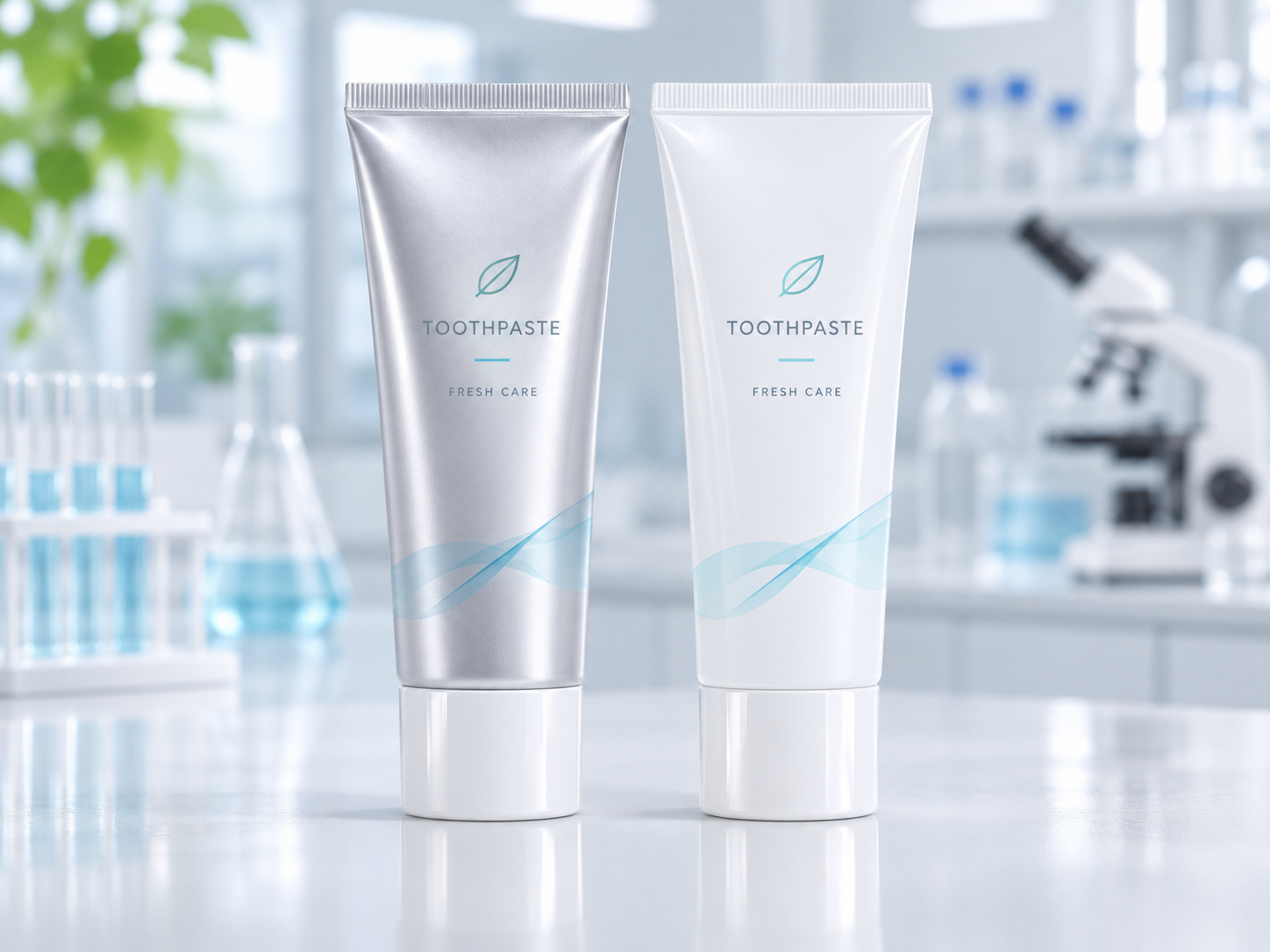
When a toothpaste formulation loses its intended flavor during storage, or a tube begins to dry out before its expected shelf life, the packaging barrier is one factor worth examining. Aluminum barrier laminate (ABL) generally provides a stronger barrier to oxygen, moisture and aroma compounds than plastic barrier laminate (PBL), because it contains an aluminum foil layer. PBL relies on polymer barrier layers and can still provide adequate protection when the structure is matched to the formulation and storage conditions.
The choice is not simply between “high barrier” and “low barrier.” A laminate’s composition, the quality of its seams, the closure and the toothpaste itself all affect protection in the finished pack. A buyer comparing samples from Shanghai Pactek Industries Co. or another supplier should therefore ask for structure-specific evidence rather than rely on the ABL or PBL label alone.
Where the barrier difference comes from
An ABL tube is made from multiple layers that typically combine plastic with aluminum foil. The foil forms a highly effective barrier when it is continuous and intact; surrounding polymer layers help provide sealing, product-contact and processing functions. The exact layer arrangement and thickness vary by construction.
PBL also uses a multilayer construction, but its barrier is provided by polymers rather than an aluminum foil layer. A common barrier polymer is ethylene vinyl alcohol, or EVOH, although not every PBL has the same barrier layer or performance. The protective effect depends on the material selected, its thickness, the surrounding layers and the conditions under which the tube is used.
Neither material name describes the whole tube. A laminate sample may perform well as a flat sheet, while the finished tube introduces a longitudinal seam, shoulder, nozzle and cap. Those features create additional paths that must be assessed before drawing conclusions about shelf life.
Oxygen: compare the measured structure, not the category
Oxygen ingress can matter when a formulation contains ingredients that are sensitive to oxidation. Depending on the product, exposure may contribute to changes in odor, color or ingredient stability. ABL’s foil layer is generally a strong starting point for such products, provided it remains intact through tube manufacture, filling and use.
For PBL, oxygen protection depends heavily on the barrier resin and construction. A thicker tube is not automatically a better oxygen barrier: adding more of a polymer with relatively high oxygen permeability may not compensate for a weak or thin barrier layer. Ask for the oxygen transmission rate of the proposed laminate, together with the test method, temperature, relative humidity and units. A number without those conditions is difficult to compare with another supplier’s figure.
Humidity deserves particular attention when EVOH is used. Its oxygen-barrier performance can be affected by moisture, so a dry-condition result may not represent the intended storage environment. Protective surrounding layers can influence how much moisture reaches the barrier, but their contribution must be evaluated as part of the complete structure.
A very low sheet transmission rate does not establish that a filled tube has equivalent protection. Leaks or permeation at a seam, closure or component interface may become important once the laminate barrier is strong. For a sensitive formulation, compare filled-tube stability as well as sheet-level data.
Moisture movement and toothpaste consistency
Toothpaste contains water and other ingredients that help determine its texture. Over storage, unwanted moisture loss can contribute to thickening or drying; moisture gain may also matter for some formulations and environments. The direction and extent of movement depend on the difference in water activity and humidity across the package, not simply on whether the tube is stored in a humid place.
Intact aluminum foil is generally an excellent moisture barrier. PBL moisture protection comes from its polymer layers, so its performance varies with the resin combination and thickness. Polyolefin layers can provide moisture resistance, while the layer selected primarily for oxygen protection may behave differently. A supplier’s water vapor transmission rate should therefore describe the complete proposed laminate, not just one constituent material.
When comparing moisture data, check the temperature, humidity conditions, test method and units. Also ask whether the measurement concerns flat laminate or a finished tube. A cap that is not closed properly, a poor shoulder joint or a damaged seal can affect real-world drying even when the laminate itself has a strong barrier.
Aroma protection is more than preventing leaks
Mint and other flavor components can change in intensity or balance during storage. Some compounds may permeate through packaging, while others can be absorbed into a polymer layer or interact with the contact surface. These mechanisms are not captured fully by an oxygen or water vapor transmission figure.
ABL’s foil layer generally limits passage through the laminate, which can make it attractive when aroma retention is a priority. It does not eliminate the need to assess the inner product-contact layer: flavor ingredients can still interact with that layer, and the closure remains part of the package. PBL may protect a particular flavor system adequately, but its suitability cannot be inferred from a generic barrier rating.
A practical comparison uses the actual toothpaste, proposed tube structures and intended closures. Evaluate the filled packs over the intended storage period and conditions, including any relevant elevated-temperature assessment. Check agreed attributes such as odor, flavor profile, appearance and consistency alongside package integrity. An accelerated study can help identify risks, but its relationship to normal shelf life must be justified rather than assumed.
Finished-tube features can change the result
The laminate is only one part of the barrier system. During tube conversion, the sheet is formed and sealed; a shoulder and closure are added; and the filled tube is sealed at the tail. Each operation needs to be compatible with the chosen material and production equipment.
For ABL, flexing or conversion damage may compromise foil continuity. For either construction, an inconsistent longitudinal seam, imperfect tail seal or poorly fitting cap can undermine protection. A tube that looks acceptable externally is not necessarily leak-tight, so visual inspection should be supported by an appropriate integrity test.
Repeated squeezing also matters. Tube recovery, folding and creasing differ by construction and can influence how the package behaves in use. A closure that seals adequately in an unopened sample may be exposed to toothpaste residue or repeated opening after purchase. Where in-use performance is important, include representative opening, closing and dispensing cycles in the evaluation.
Choosing between ABL and PBL for a formulation
Start with the failure you need to prevent
Identify whether the primary concern is oxidation, water loss, flavor change or a combination. A formulation with pronounced sensitivity to oxygen or aroma loss may justify starting with ABL, particularly when the target storage period is demanding. PBL is worth assessing when the product is less sensitive, or when an appropriately designed polymer barrier can meet the required protection while supporting the desired tube appearance and handling.
A visually attractive PBL sample is not proof of adequate barrier. Equally, choosing ABL does not remove the need to check formulation compatibility or the seal system. The useful question is whether a specific construction keeps the product within its acceptance criteria in a finished pack.
Define the conditions before requesting data
Provide the supplier with the intended product type, target shelf life, expected storage and distribution conditions, tube dimensions, closure style and filling requirements. Identify any known sensitivities without assuming that a single transmission rate will predict product stability. Ask which side of the laminate will contact the toothpaste and whether that layer is suitable for the formulation.
Request a description of the proposed layer structure and relevant test data for that exact construction. If two quotations use different test temperatures, humidity levels or measurement units, clarify the differences before ranking them. Where available, examine the normal range or specification limits rather than treating one reported result as a guarantee for every production roll.
Can't find what you're looking for ?
Leave a Message we will call you back quickly!
Product Classification
Professional Service
Interested? Leave your contact details.
Search Starts Here