
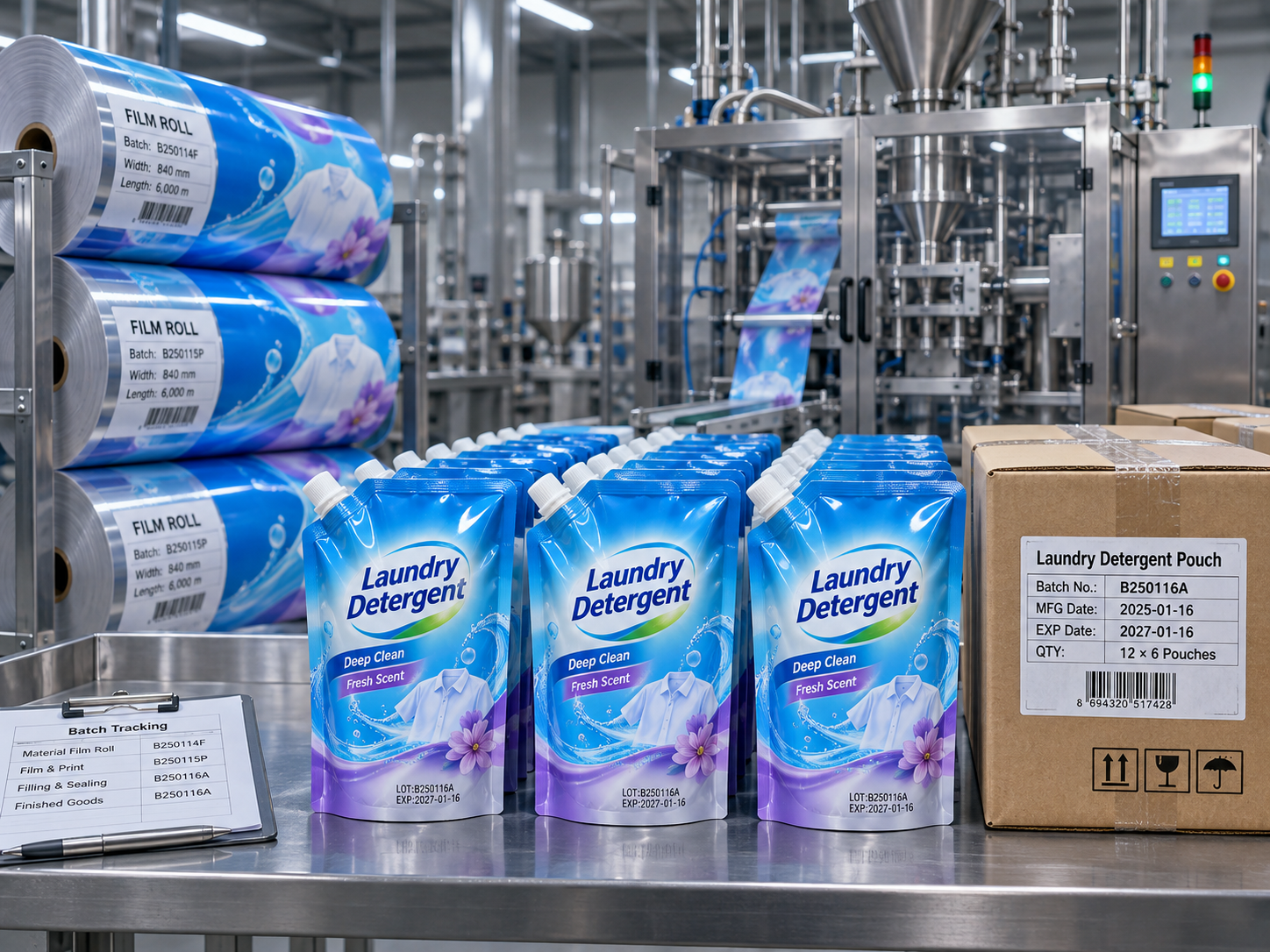
1. The Chain: From Laminate Roll to Filled Pouch
A pouch is rarely made from a single material. It involves multiple inputs: laminate film, zippers, spouts, caps, and inks.
At the Pouch Factory: We record exactly which raw material lots (e.g., Lot A of PET film, Lot B of Aluminum foil) were used to produce your specific pouch batch.
At Your Filling Plant: When the pouches arrive, they are assigned a production lot by your filler. This lot is then linked to your specific filling run, your product batch, and finally, the shipping destination.
2. What is Actually Being Identified? (The Identifier Matrix)
This is where most brands get confused. A string of numbers on a box can mean five different things. You must clearly define what each code represents in your contract.
3. Backward vs. Forward Traceability
Backward Traceability (Root Cause): You start with a leaking finished pouch and ask: "Where did this specific film come from? Which machine made it?" This helps you identify the exact laminate lot or spout lot that failed.
Forward Traceability (Containment): You start with a suspect raw material lot (e.g., your film supplier warns that a specific adhesive was defective) and ask: "Which of my customers received pouches made from this material?" This allows you to recall only the affected stock, saving millions in unnecessary recalls.
4. Record-Keeping: Paper vs. Digital Systems
How you record the data determines how fast you can react during an audit or a crisis.
5. The Warehouse Blind Spot (Where Traceability Breaks)
Here is the harsh reality of the factory floor: Traceability often stops at the warehouse door.
When a line worker opens a box of 10,000 pouches and dumps them into the hopper of a filling machine, the case label is often discarded. If multiple lots of pouches are mixed in the same hopper, tracing a specific defect back to a specific production shift at the pouch factory becomes virtually impossible.
How to fix this:
Ensure the line worker records the exact time a new box of pouches is opened.
Do not mix lots in the hopper. Finish one lot completely before starting the next.
The Pactek Factory Edge:
At Shanghai Pactek Industries Co., Ltd, we treat traceability as a core quality control pillar. Every shipment of pouches is accompanied by a detailed Batch Record Certificate, tracing the laminate film, the spouts, and the inspection reports back to the exact raw material lot. Don't let a traceability gap ruin your brand. Contact us today to discuss how we structure our QA documentation for your specific regulatory needs.
Can't find what you're looking for ?
Leave a Message we will call you back quickly!
Product Classification
Professional Service
Interested? Leave your contact details.
Search Starts Here