
The Anatomy of a Pouch
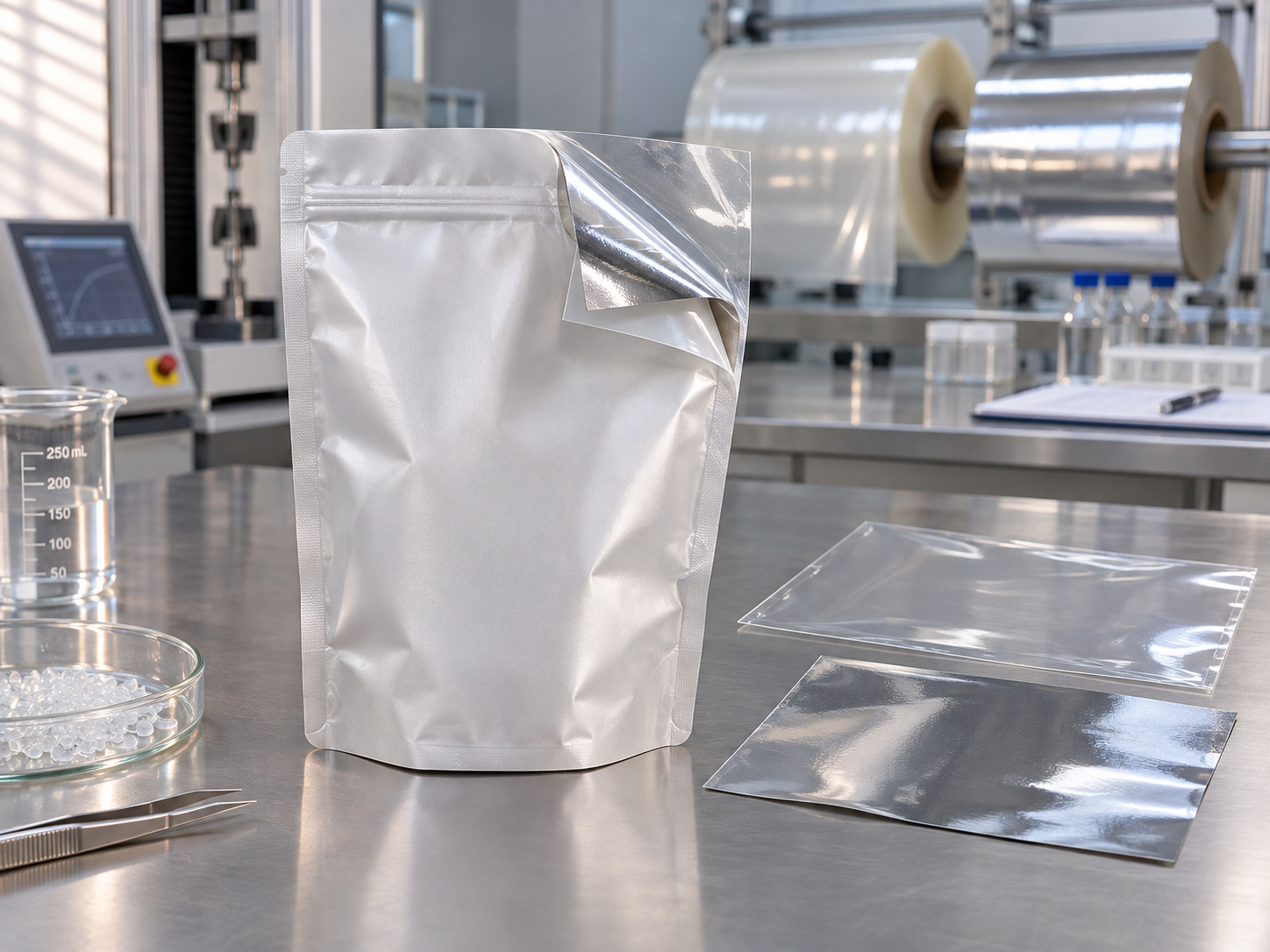
A pouch is not a single film; it’s a multi-layer sandwich. Each layer has a specific job:
Outer Layer (Printability & Strength): Usually PET or BOPP. Provides a high-gloss finish and puncture resistance.
Middle Layer (The Barrier): Aluminum Foil (AL), Metallized Film (VMPET), or EVOH. Blocks oxygen, moisture, and light.
Inner Layer (Sealant & Contact): Food-grade PE or CPP. Melts to form the seal and touches your product.
Comparing the Main Material Options (Factory Matrix)
1. General-Purpose Plastics (PET/PE)
This is your workhorse structure. It is perfect for dry goods, personal care refills, and products with a moderate shelf life.
Pro Tip: If you need transparency, we can use clear PE. If you need a high-barrier, we add a thin EVOH layer instead of aluminum.
2. Nylon (PA) for Toughness
When your product has hard edges (like frozen seafood or pet treats with bone fragments), standard PET will puncture. Nylon provides incredible drop and puncture resistance.
Pro Tip: Nylon is moisture-sensitive. If the product is liquid, we must place the nylon layer in the middle or use a specific tie-layer to prevent it from delaminating.
3. Aluminum Foil (AL) for Absolute Protection
This is the premium choice for coffee, pharmaceuticals, and sensitive chemicals. It offers absolute protection against oxygen, moisture, and UV light.
Pro Tip: Foil is fragile. We use high-quality adhesives and strict tension control during lamination to ensure the foil doesn't develop micro-cracks during the filling process.
4. Metallized Films (VMPET) for Cost-Effective Barrier
A vacuum-deposited aluminum layer on PET film. It gives you a shiny metallic look and a good barrier at a lower cost than solid foil.
Pro Tip: A metallized layer is not as robust as foil. It can be scratched during printing or sealing. We closely monitor our seal coatings to protect it.
5. Recyclable Options (Mono-Material PE or PP)
The EU and North America are pushing hard for recyclability. Multi-layer structures are hard to recycle. To solve this, we offer Mono-PE or Mono-PP structures.
Pro Tip: Standard PE cannot handle high heat or oxygen. To make Mono-PE work, we use specialized high-barrier MDO-PE (Machine Direction Oriented PE) films. The trade-off is higher cost and narrower sealing windows.
Don't Guess — Test the Finished Pouch
Reading material specs is one thing, but how the finished pouch behaves on your automated filling line (VFFS/HFFS) is another.
Coefficient of Friction (COF): If the film is too slippery, it won't track straight. If it's too sticky, it jams.
Powder Contamination: If filling powder gets trapped in the seal area, it causes micro-leaks. We engineer our inner sealant layers to seal through contamination.
Hot Filling: If you are filling hot liquids (like sauces), the pouch must be designed with heat-resistant layers to prevent the seams from peeling.
The Pactek Factory Edge:
Send us your product description, filling weight, and machine specs. Our engineering team will recommend the exact micron thickness, barrier architecture, and seal parameters. Request a free consultation with our packaging experts today.
Can't find what you're looking for ?
Leave a Message we will call you back quickly!
Product Classification
Professional Service
Interested? Leave your contact details.
Search Starts Here