
How Do You Test a Spout Pouch for Leaks? Start by Asking Which Leak
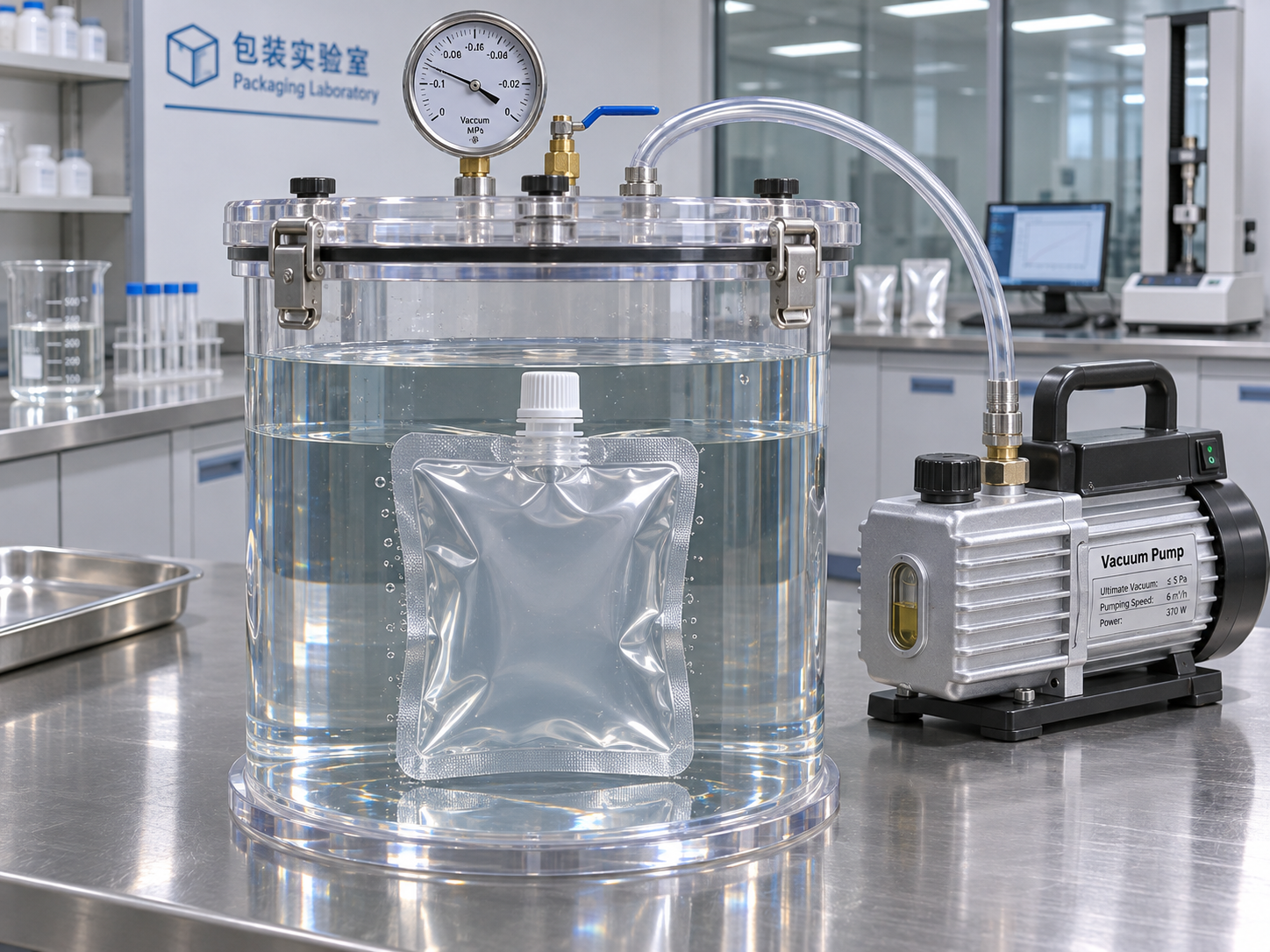
Ask a packaging laboratory how a spout pouch is tested for leaks and the honest answer is uncomfortable: there is no single test. "Leak testing" is a family of methods with different physics, different detection capabilities and different blind spots. A report that states "leak test: passed" without naming the method, its sensitivity and the basis of acceptance carries very little information — and it is usually the document that both sides argue over afterwards.
Step 1: map the leak paths before choosing a method
A spout pouch is an assembly. Each interface fails differently, and a method that performs well on one interface can be blind on another.
A test limited to the side seal will not find a flange channel, and a test run on an empty pouch will not describe how the package behaves when it is filled.
Step 2: match the method to the path — and to what you need to prove
Two consequences follow. First, seal strength and leak integrity are different properties: strength is measured on a cut test strip, while a leak is a three-dimensional path through the assembled package, so an acceptable peel force does not by itself prove that the pouch will not leak. Second, the choice of method is also a commercial choice. Destructive methods consume samples and cannot support 100% inspection; vacuum decay can be applied to every package, but it requires a fixture, a validated method and a controlled acceptance threshold.
Step 3: understand that "pass" is always relative to sensitivity
The same pouch can pass one method and fail another, because the methods do not see the same defect size. A channel of about 20 µm may be invisible to a 50 µm-class dye procedure yet be detectable by a vacuum-decay setup that reports holes of around 5 µm . This is why the sensitivity of the method should appear next to the result in the report. Comparing figures across methods, or across laboratories, without normalising for sensitivity produces disputes that are really about definitions rather than about quality.
Step 4: test the package in the state in which it actually fails
A leak test on an empty, freshly sealed pouch is a production-control test. It is useful, and it is not sufficient.
Filled or empty. Headspace volume, product viscosity and residue in the spout all change the result, so a value obtained on an empty pouch cannot be transferred automatically to the filled configuration.
Before or after logistics. A pouch may seal correctly and only develop a flange channel after drop, compression and temperature cycling. Testing after transport simulation is a separate line item, not an optional extra.
At the torque limits. Because the closure is itself a leak path, testing at the lower and upper torque limits — and not only at nominal torque — is what reveals the seepage that customers later report.
Chinese standard context. In China, GB/T 15171-2025 "Test method for sealing performance of package" specifies two methods, underwater bubble emission and vacuum decay. It applies to non-vacuum packages, including sealed packages that contain no contents, and it replaced GB/T 15171-1994 with effect from 1 February 2026 .
Step 5: acceptance criteria have to be established, not copied
The vacuum decay method describes its own logic: accept and reject criteria are set by comparing measurements from known leak-free control packages with measurements from packages carrying a simulated leak introduced through a calibrated volumetric airflow meter . That logic has a commercial consequence. A threshold borrowed from another product, or agreed only after a failure has already occurred, is difficult to defend in a claim. The same applies to sampling: a handful of samples showing no defects is not evidence about a batch, and the sampling plan should be settled in the RFQ instead of negotiated after a complaint.
What a passed leak test still does not prove
A leak test answers one question: whether a continuous path exists now, under the tested conditions. It does not demonstrate barrier performance or shelf life, which depend on transmission-rate testing and stability data. It does not cover long-term stress relaxation or creep in the spout weld. And it does not extend to consumer misuse beyond the torque and flexing conditions actually tested. Buyers who treat a leak-test report as a shelf-life certificate are usually the ones who reopen the same argument a year later.
What to include in the RFQ
Five items remove most of the ambiguity: the leak paths to be covered; the method and its stated sensitivity for each path; the basis of acceptance, whether control packages plus simulated leaks or an agreed qualitative criterion; the test states, meaning empty or filled, before or after transport simulation, and the torque limits; and the sampling plan, including sample size and the disposition of rejected units.
We do not publish catalogue test values. Where a quality programme requires data, testing is arranged through accredited third-party laboratories on the structure and configuration actually ordered, before mass production. Our packaging is produced under an ISO 9001 quality management system with batch traceability, and customer audits plus quality document packages are supported.
This article is a general technical note for procurement and packaging teams. For a review of an existing spout pouch test plan, send us the drawing, the filling conditions and the report currently in use.
Can't find what you're looking for ?
Leave a Message we will call you back quickly!
Product Classification
Professional Service
Interested? Leave your contact details.
Search Starts Here