
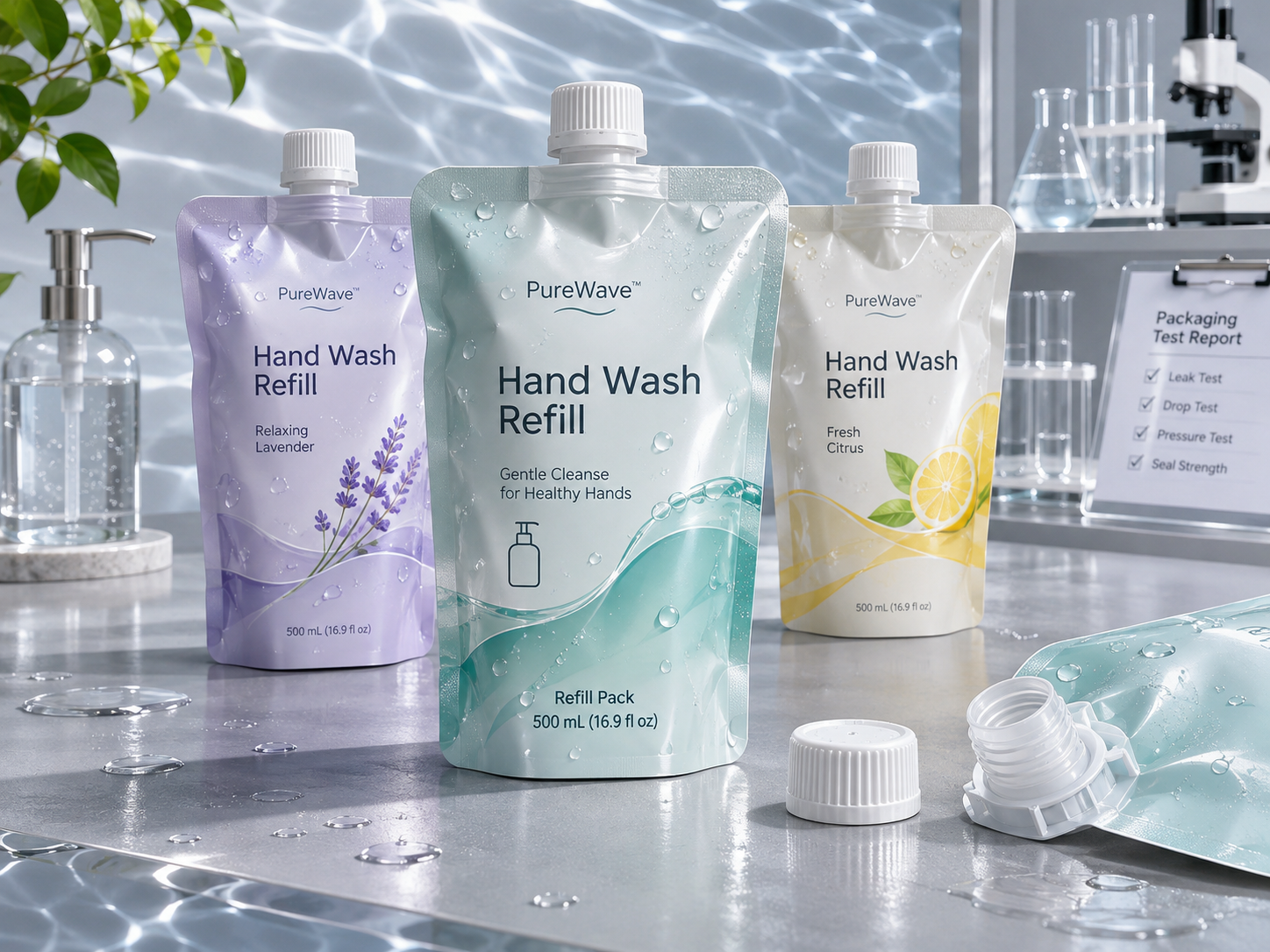
Can Spout Pouches Be Used for Cosmetic Refills? Yes — If the Closure Is Engineered, Not Just the Film
Refill formats have moved from niche to mainstream in personal care, and the spout pouch is the first structure most brands consider. It ships light, it collapses as it empties, and it uses materially less plastic than a rigid bottle. The question is rarely whether it is possible. The question is which part of it will fail first.
In our experience supplying flexible packaging into personal-care programmes, the answer is consistent: the pouch body is the easy part. The failure modes concentrate at the spout.
Which formulations actually suit a spout refill
Spout pouches behave well with low- to medium-viscosity products that flow predictably through a round spout — shampoos, shower gels, liquid hand soaps, some toners and micellar waters. These are also the categories where refill stations and at-home refill sachets are already established.
Thicker and more demanding formats need a different conversation. High-viscosity creams, anhydrous oils and formulations with suspended particles put pressure on spout diameter, drip control and air entrapment during filling. And formulations carrying oxygen-sensitive actives raise a barrier question that a mono-material spout pouch cannot always answer on its own.
So the honest answer to "can it be used" is: yes for a defined set of formulations, and only after the formula, the fill temperature and the target shelf life have been stated.
Where the failure modes sit
The spout neck and cap interface. Threads, sealing rings and torque tolerance are the highest-risk area in a refill format. If capping torque is set too high, the thread can be stressed before the consumer ever opens it; too low, and the closure weeps during transport. Cross-threading and cap seizing are frequently reported by consumers as "leaking packaging," when the root cause is a torque window that was never specified.
Residual product in the spout. During filling and after use, product remains in the spout neck. In viscous or sticky formulas this residue can dry, partially block the spout, or glue the cap to the neck. This is a filling-and-design issue — spout height, freeboard and fill volume matter more than the film grade.
Leakage during transport, not on the shelf. A spout pouch that passes a static shelf test can still fail under drop, compression and temperature cycling, because the spout is a rigid feature on a flexible body. Transport simulation and drop testing are worth specifying rather than assuming.
Recyclability of the assembled package. A spout pouch is rarely one material: film, spout and cap often differ. Mono-material PE or PP constructions are the cleanest path into existing recycling streams, but formal recognition is a third-party process — schemes such as RecyClass in Europe and APR design recognition in North America set the criteria and issue the outcomes. We design to those constraints and support the testing; we do not issue certificates.
What a buyer should specify
Treat four items as line items in the specification, not as assumptions:
1.Spout type, neck finish and cap torque window — confirmed by the pouch manufacturer, recorded in the document set.
2.Fill conditions — fill temperature, fill volume, freeboard around the spout, and the acceptable residual product in the neck.
3.A pre-production verification round — torque check after storage, leak and drop checks, and a simple drip test with the actual formula.
4.The recyclability target — stated up front, so film, spout and cap are chosen together instead of the cap being selected last.
Product-level testing of this kind — torque, leak, drop and seal verification — is arranged through accredited third-party laboratories according to your market requirements, before mass production, so the data matches the structure you actually receive. Our packaging is produced under an ISO 9001 quality management system with batch traceability, and customer audits plus quality document packages are supported.
The takeaway
Spout pouches are a legitimate refill format for a defined range of cosmetic products. Brands that avoid the usual complaints are usually the ones who stopped treating the spout as an accessory and started treating it as a closure system with its own tolerance stack.
This article is a general technical note for procurement and packaging teams. For a feasibility review of your own refill concept, send us the formula type, fill temperature and target shelf life.
Can't find what you're looking for ?
Leave a Message we will call you back quickly!
Product Classification
Professional Service
Interested? Leave your contact details.
Search Starts Here