
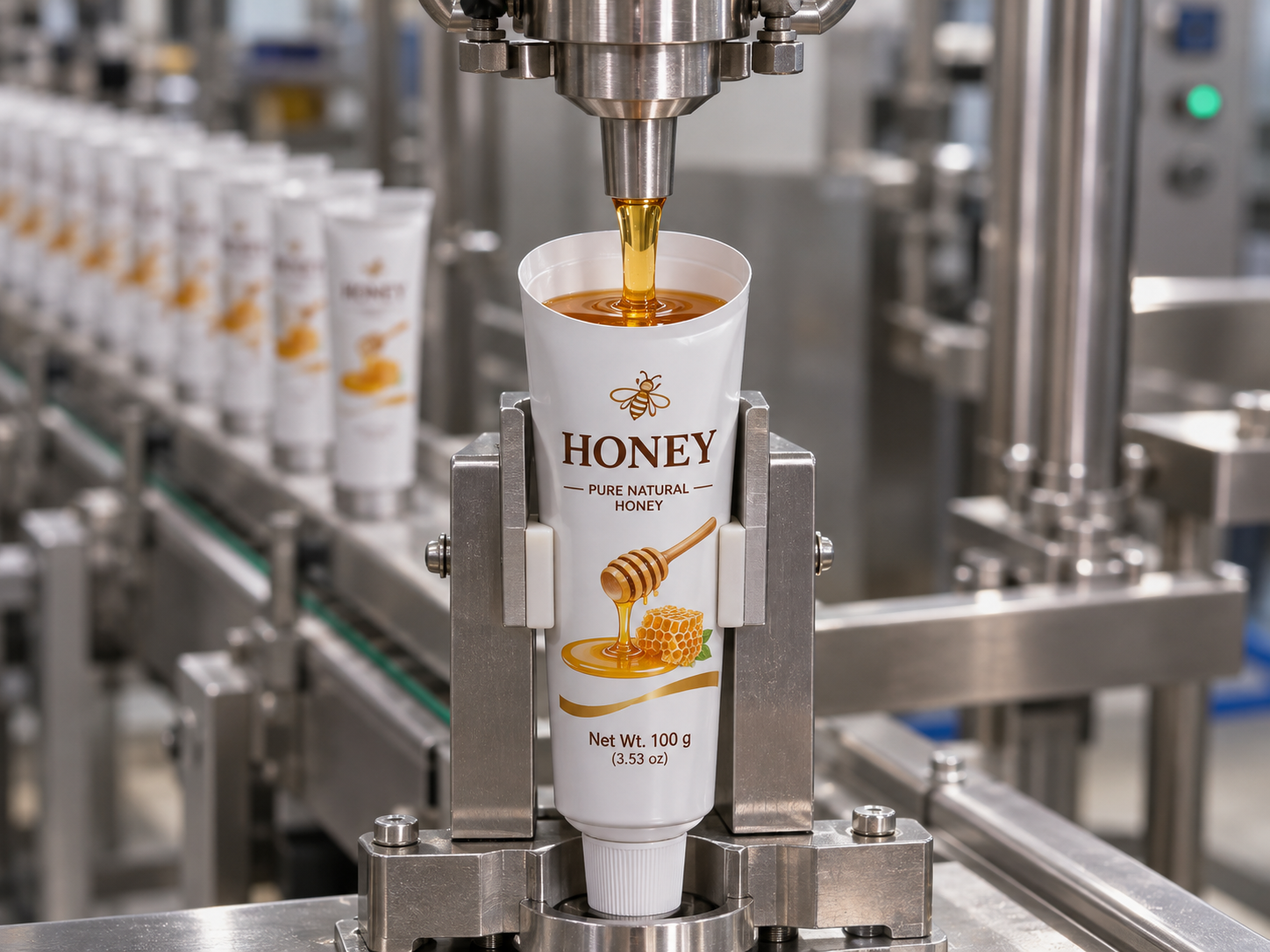
A honey filling line can seem well adjusted at the start of a shift, then begin to struggle as the product cools. The nozzle takes longer to finish each dose, the target weight drifts, and a sticky thread appears where the tube should be clean for sealing. These changes are often connected: honey’s temperature affects its viscosity, which in turn influences how it moves through the equipment and settles inside the pack.
For operators working with a food grade ABL tube for honey, the practical question is not simply how warm the honey should be. It is how to keep the product flowing consistently without exposing it to unnecessary heat, introducing excess air, or compromising the tube seal. The right settings depend on the honey, tube specification, filling machine, and quality requirements of the finished product.
Why honey behaves differently from one run to another
Honey is a concentrated sugar solution, but it is not a uniform industrial liquid. Its flow can vary with moisture content, composition, temperature, and crystallization. A batch that moves readily through a pump may become noticeably harder to fill after sitting in a cool hopper. Another may contain fine crystals that change how it flows and how cleanly it cuts off at the nozzle.
As honey cools, it generally becomes more viscous. The pump must work harder, pressure losses through hoses and fittings increase, and the product may continue moving after the dosing cycle has ended. When honey is warmer, it usually flows more easily, but that does not mean hotter is always better. Excessive heating or prolonged holding can affect flavor, color, and other quality characteristics.
Operators should also distinguish between liquid honey and products deliberately prepared with crystals, such as creamed honey. A setting developed for clear liquid honey may not provide the same fill consistency or texture for a crystallized product. Treat a change in honey type as a reason to review the setup, not merely as another batch on the schedule.
Choosing a filling temperature: start with the product limit
There is no single filling temperature that is correct for every honey and every ABL tube. The operating target should sit within the honey producer’s approved processing limits and the tube and machine suppliers’ specified ranges. Within those limits, the goal is to find a temperature at which the honey flows predictably and the equipment can dose and seal reliably.
Before starting a trial, bring together three sets of information:
- Product requirements: the approved temperature range, permitted holding time, and any restrictions intended to protect flavor, appearance, or texture.
- Packaging requirements: the tube’s food-contact suitability and the supplier’s guidance on filling and sealing conditions.
- Equipment capability: temperature control, pump suitability, nozzle design, and the available sealing settings for the laminate structure.
Measure the honey where it matters. A heater display may show the jacket setpoint rather than the actual product temperature, while honey in a hopper can be warmer than honey reaching a long, cool filling hose. During a trial, check the product at representative points using a suitable, clean temperature probe. Follow the site’s hygiene procedure and avoid introducing contamination through the measurement point.
Temperature consistency is often more useful than repeated adjustment. If the honey reaches the filler at a stable temperature, operators can evaluate fill weight and nozzle behavior without guessing whether the product has changed during the test. Keep heating controlled and limit hot holding to the approved process; do not use heat as a shortcut for every filling problem.
What if the honey has crystallized?
Crystallization is a natural change in many honeys, not automatically a sign that the product is unsuitable. The appropriate response depends on the intended finished texture. If the specification calls for liquid honey, follow the producer’s validated procedure for dissolving crystals, including its temperature and time limits. If crystals are part of the intended product, excessive warming may change the texture that consumers expect.
Do not assume that a warm tank guarantees uniform product. Check for remaining crystals or temperature differences according to the site’s sampling procedure. Gentle, suitable mixing may help maintain uniformity where the product and equipment allow it, but vigorous agitation can introduce air.
How viscosity changes the filling setup
Viscosity is not just a laboratory value. On the line, it appears as slower flow, pressure variation, delayed nozzle cutoff, or inconsistent weights. A measured viscosity can be useful for comparing batches, but only if the measurement method, product temperature, and test conditions are recorded. A number taken at one temperature should not be treated as directly equivalent to a number taken at another.
Several parts of the process deserve attention when the honey becomes thicker:
- Product path: Long hoses, narrow passages, and unnecessary bends increase resistance. Use a suitable product path approved for the equipment rather than trying to compensate indefinitely with pressure.
- Pump and dosing system: Confirm that the system is suitable for viscous foods and can deliver a repeatable dose without damaging the product or drawing in air.
- Nozzle: A nozzle suited to honey should allow controlled flow and a clean cutoff. Its size and position must also fit the tube opening and filling method.
- Cycle time: Thick honey may need more time to move and settle. Increasing line speed before confirming complete, repeatable dosing can create more rejects rather than more usable output.
Watch the actual fill, not just the machine screen. If honey forms a long string as the nozzle retracts, it may touch the tube wall or open end. If the dose falls too quickly or from too great a height, it may trap air or splash into the sealing area. Nozzle depth, dosing speed, and cutoff settings should be assessed together, within the machine supplier’s guidance.
Filling a food grade ABL tube for honey without contaminating the seal
An ABL tube is a laminate tube that includes an aluminum barrier layer. For honey, the complete packaging structure—not simply the presence of aluminum—must be suitable for the intended food contact and filling process. The food-contact layer, tube construction, cap, and finished seal all need to be considered as a system.
In a typical tube-filling operation, honey is dispensed through the open end before that end is sealed. The area that will form the seal must remain clean and free from product. Honey on the inner sealing surfaces can interfere with bond formation, making a seal look acceptable at a glance while leaving a potential leak path.
Set the fill volume and nozzle movement so that the product remains below the intended sealing area, with appropriate space for the tube and equipment design. The required allowance is not universal: confirm it with the tube supplier and validate it on the actual line. Excessive product movement, foam, or an overfilled tube can defeat an otherwise sound sealing setup.
The sealing conditions must also match the laminate. Heat, pressure, and dwell time interact, and settings used for another tube material should not automatically be copied. Use the tube and machine suppliers’ recommendations as the starting point, then verify the finished seal through the site’s approved inspection and test methods. Visual checks are useful, but they should not replace the required seal-integrity testing.
A practical startup and adjustment routine
When the product and packaging are ready, a short, disciplined trial is more informative than changing several controls at once. The following sequence gives operators a way to connect what they see with the condition that may have caused it.
- Confirm the batch condition. Check identity, appearance, approved temperature, and whether the honey is intended to be liquid or crystallized. Record any unusual variation before filling.
- Prepare the line. Verify cleanliness and product-path assembly under the site’s food safety procedures. Check that the tube, cap, nozzle, and sealing tooling match the job specification.
- Stabilize the product. Bring the honey to the approved trial condition and allow the relevant parts of the product path to reach a stable operating state. Measure actual product temperature rather than relying only on a control setting.
- Run a small trial. Observe flow, cutoff, tube positioning, and seal cleanliness. Check fill weight using the site’s sampling plan and calibrated equipment.
- Inspect and test sealed tubes. Look for honey in the seal area, incomplete or uneven seals, leaks, and tube damage. Perform the specified seal-integrity checks before approving the run.
- Adjust one factor at a time. If the result is outside specification, investigate the likely cause and make a controlled change. Record the setting and outcome so the next shift can reproduce the result.
For example, if weights begin to fall while the temperature at the nozzle also drops, investigate cooling in the product path before simply increasing the dose setting. If weights remain stable but seals become sticky, focus on nozzle cutoff, filling position, and product clearance. Both faults may involve viscosity, but they do not necessarily call for the same correction.
Reading the warning signs on the line
Fill weight varies between tubes. Check product temperature stability, hopper level, trapped air, and the condition of the dosing system. Thick product can make an existing equipment issue more visible. Confirm that the sampling method and weighing equipment are reliable before making large changes.
Honey drips or strings from the nozzle. Examine cutoff timing, nozzle condition, and product flow. Warmer honey may flow more easily, but excessive flow after cutoff can still create contamination. A temperature change alone may move the problem rather than solve it.
Seals leak or separate. Isolate affected product according to the site procedure. Check for honey in the sealing zone, tube alignment, and sealing settings. Do not raise sealing temperature without checking the laminate specification; excessive heat can also damage the tube or seal.
Air pockets appear in the filled tube. Review how the honey enters the hopper and travels through the pump, as well as nozzle position and dosing speed. Air can affect fill consistency and appearance, so address its source rather than relying on the seal to contain it.
The product changes during a long run. Compare current readings with startup records. Ambient conditions, heat loss, and holding time may alter product behavior. Recheck at intervals established by the production procedure, especially after a stoppage.
What to confirm when sourcing the tube
A tube that looks suitable on a sample table still needs to perform with the actual honey and filling line. Ask the packaging supplier for the relevant food-contact documentation for the intended market and use, along with the laminate structure and recommended processing information. Discuss tube dimensions, opening and cap configuration, filling direction, and the sealing equipment before approving a specification.
It is also sensible to trial the complete pack under expected production conditions. Evaluate dosing, seal integrity, dispensing, and product compatibility using the manufacturer’s established test plan. Storage and distribution conditions matter too: a tube should be assessed as a finished, filled package rather than as an empty component alone.
Shanghai Pactek Industries Co., Ltd. supplies laminate packaging solutions and works with manufacturing partners on customized procurement. For a honey application, sharing the product characteristics, target market, line equipment, and expected pack format gives the supplier a useful starting point for discussing an appropriate tube specification and trial requirements.
A reliable honey filling process is built on a workable balance: enough flow for accurate dosing, controlled heat to protect the product, and a clean sealing area matched to the laminate. Once that balance is established, clear records of temperature, settings, checks, and results make it easier to maintain from one batch—and one shift—to the next.
Can't find what you're looking for ?
Leave a Message we will call you back quickly!
Product Classification
Professional Service
Interested? Leave your contact details.
Search Starts Here