
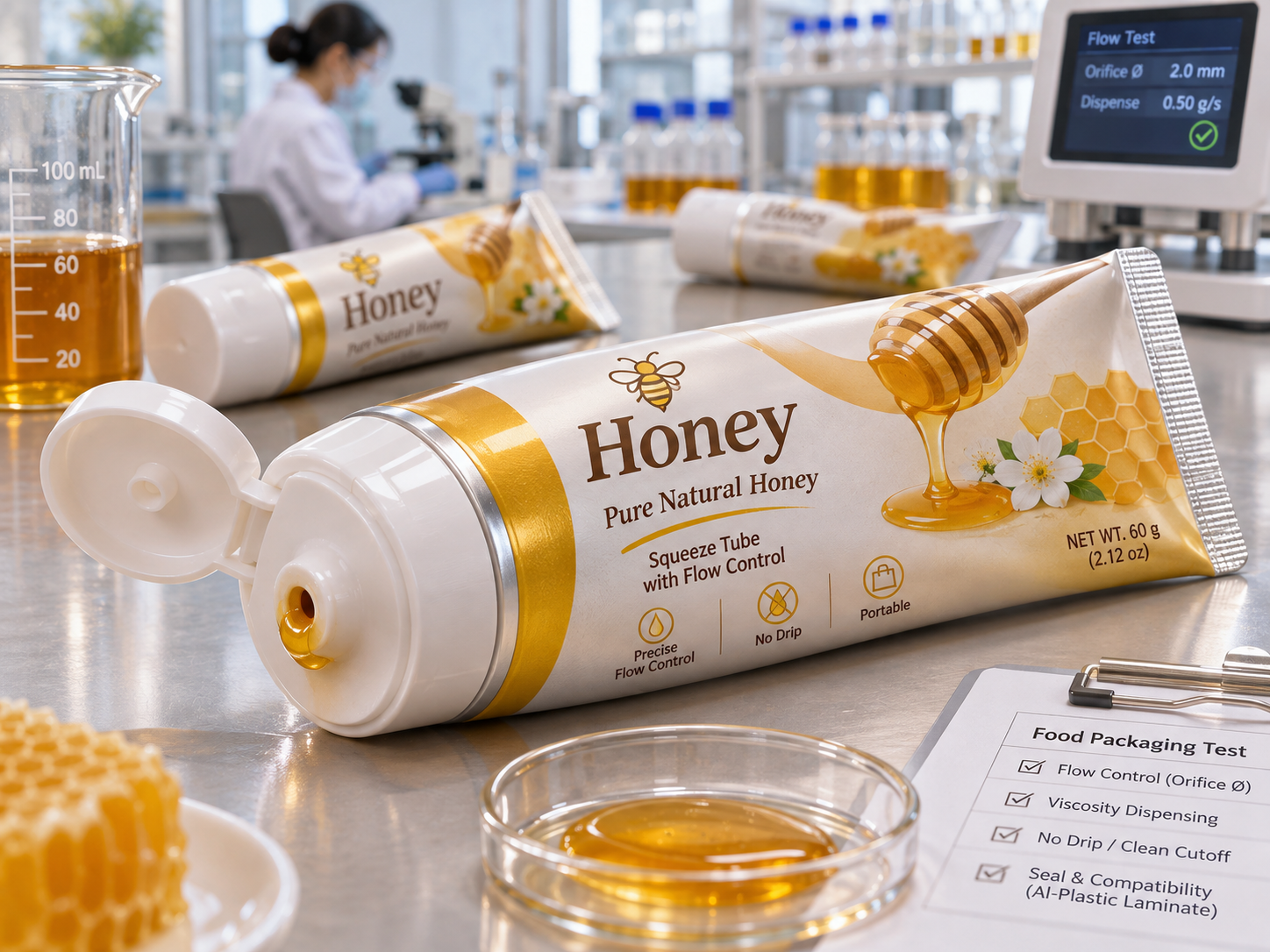
The opening of a honey tube influences dispensing precision, flow control, and product cleanliness. For technical evaluators, selecting a food grade ABL tube for honey involves more than choosing a convenient cap.
Opening diameter, honey viscosity, seal integrity, and material compatibility all merit assessment. This article examines how opening designs affect dispensing performance and outlines practical considerations for selecting a configuration suited to the product and its intended use.
In general, begin with the smallest opening that delivers the required flow under realistic conditions, then verify that it remains clean, sealable, and practical to manufacture.
How Does Opening Diameter Affect Honey Dispensing?
Opening diameter controls the restriction at the outlet. A smaller opening can improve portion control, but it also increases resistance and may require greater squeezing force.
A larger opening generally reduces resistance and helps dispense viscous honey more quickly. However, it can make small portions harder to control and increase residual honey around the tip.
These effects are not determined by diameter alone. Outlet length, internal geometry, shoulder design, tube flexibility, and closure construction also influence the dispensing experience.
For a first comparison, test several opening sizes with the actual honey formulation and intended tube structure. A diameter that works for liquid honey may perform poorly with a crystallizing product.
Record the time needed to dispense a defined portion, the force required, and the amount remaining at the outlet after dispensing. Compare results across representative temperatures.
Avoid treating a supplier's nominal diameter as the entire specification. Confirm whether the measurement refers to the narrowest internal passage, the visible tip opening, or another feature.
Which Opening Design Fits the Intended Application?
The appropriate opening depends on whether the user needs a thin stream, a quick serving, or repeated dispensing with minimal cleanup. Each objective places different demands on the package.
Small Orifice for Controlled Portions
A small, round orifice can support thin lines and measured additions to drinks, yogurt, or recipes. It is especially relevant when users value precision over dispensing speed.
The trade-off is higher resistance. Thick honey, low temperatures, or early crystallization can make the tube difficult to squeeze or produce an uneven stream.
Assess whether the target consumer can comfortably dispense the desired quantity without excessive hand force. Include children or users with limited grip strength when relevant.
Wider Opening for Faster Flow
A wider outlet can make larger servings easier to dispense and may better accommodate a viscous formulation. It can also reduce frustration when the product is cool.
However, flow may continue briefly after squeezing stops, particularly when the tube is held downward. Evaluate overshoot, dripping, and the ability to stop at the intended portion.
A wider tip also presents more exposed product near the closure. Check whether the cap interior collects honey and whether users can close it without spreading residue.
Shaped Nozzles and Flow-Control Features
A tapered nozzle may help direct honey onto a specific area, while a recessed or protected tip can reduce accidental contact. Actual performance depends on detailed geometry.
Some closures incorporate valves or other flow-control elements. These can potentially reduce leakage or dripping, but introduce additional components, cost, and compatibility questions.
For any valve, assess opening pressure, closing consistency, cleanability, and performance after repeated use. Confirm that the valve material is suitable for the product and intended market.
Do not assume a valve is necessary for every food grade ABL tube for honey. A well-matched plain orifice and cap may meet the same functional requirements with fewer components.
How Do Viscosity, Temperature, and Crystallization Change the Choice?
Honey is a variable natural product. Botanical source, water content, processing, and storage history can affect flow behavior, even when products appear similar during an initial inspection.
Lower temperatures generally make honey more resistant to flow. A design that dispenses comfortably in a warm laboratory may require substantially more force in a cool kitchen.
Test at temperatures representing distribution, storage, and use in the intended markets. Let filled samples reach the target temperature before evaluating flow and squeezing force.
Crystallization introduces a separate issue. Crystals or a partially crystallized texture may obstruct a narrow passage, produce inconsistent dispensing, or leave deposits around the closure.
Test the formulation in its expected condition throughout shelf life, including partially crystallized samples where relevant. Do not rely solely on freshly filled, fully liquid product.
For creamed or deliberately crystallized honey, evaluate texture and particle size alongside the outlet geometry. The opening must accommodate the product without undermining the desired serving experience.
If warming is part of the recommended consumer handling process, confirm that the complete package tolerates the stated conditions. Do not assume every tube, cap, or seal is suitable for heating.
What Makes an ABL Tube Suitable for Food Contact?
ABL, or aluminum barrier laminate, is a multilayer structure that typically combines an aluminum barrier with polymer layers. The exact construction and food-contact surface depend on the specification.
The aluminum layer can provide a strong barrier against oxygen, moisture, and light when the laminate and finished package are properly designed. The complete package still requires validation.
In particular, the closure, shoulder, seals, and tube seams can affect overall protection. Material barrier properties alone do not establish the performance of the filled, sealed tube.
Food-grade status is not a universal certificate covering every application. It must be assessed against the intended market, food type, contact conditions, and applicable regulations.
Request declarations of compliance for the relevant food-contact components, including the inner laminate layer, shoulder, closure, seal, and any valve that may contact honey.
Ask suppliers to identify applicable legislation and supporting evidence for the intended use. Depending on the market, this may include migration data, formulation information, or other appropriate documentation.
Review test conditions carefully: food simulants, contact time, temperature, and component coverage should be appropriate to the proposed application. A declaration alone does not replace product-specific assessment.
Also evaluate sensory compatibility. Store honey in representative finished packages and check for changes in odor, flavor, appearance, or consistency against a suitable control.
Which Seals and Closures Protect the Product?
A closure must provide a reliable seal during storage and transport while remaining convenient to open and close. Its performance should be assessed with the chosen nozzle and tube.
Screw caps can provide a secure reclosure when correctly designed and applied. Flip-top caps may support convenient repeated use, but hinge durability and snap engagement require evaluation.
For either style, verify that honey residue does not prevent full closure. Include repeated-use testing because a clean, newly filled sample may not reveal this risk.
An induction seal or another suitable membrane may provide an additional initial barrier and visible evidence of opening, depending on the package design and applicable requirements.
Specify seal materials, sealing equipment, application settings, and inspection criteria together. A membrane must be compatible with the sealing surface and robust enough for distribution.
Test membrane removal as well as integrity. Users should be able to access the product without leaving fragments, damaging the nozzle, or contaminating the dispensing area.
If tamper evidence is required, define what constitutes visible evidence and confirm compliance with relevant market rules. Do not assume that every liner or cap feature qualifies.
How Should Technical Evaluators Test Dispensing Performance?
Build a test plan around measurable acceptance criteria before comparing samples. Include the actual formulation, target fill weight, intended closure, and representative production components.
Start by defining the serving size and acceptable dispensing time. Measure multiple filled tubes and operators so that an isolated favorable result does not determine the decision.
Use a consistent method to measure squeezing force where equipment is available. Record tube orientation, dispensing duration, temperature, fill level, and the location where force is applied.
Evaluate both full and partly emptied tubes. As the package empties, changes in tube shape and available product can alter flow, control, and the amount left behind.
Measure portion variability across repeated dispensing cycles. Note whether the stream starts predictably, whether it breaks cleanly, and how much product continues flowing after pressure is released.
Inspect the nozzle and closure after each cycle for buildup, sticking, and contamination risks. Include a realistic interval between uses so residue can behave as it would in practice.
Check leakage with the cap closed in upright, inverted, and horizontal positions. Add transport simulation and temperature exposure where these represent the intended distribution conditions.
Examine the tube body, longitudinal seam, shoulder joint, tail seal, and closure after testing. Investigate any deformation or leakage before attributing the issue solely to the opening.
Finally, verify results on production-representative samples. Prototype tooling, manual filling, and laboratory sealing can differ materially from the components and processes used at commercial scale.
What Should Be Specified Before Requesting Samples?
Provide the supplier with the honey type, expected viscosity or texture, crystallization behavior, target fill volume, and relevant storage and distribution conditions.
Describe the intended use: controlled drizzling, single servings, or faster dispensing. Include target portion size, user requirements, preferred closure style, and any initial seal requirement.
Request drawings showing critical dimensions and tolerances, particularly the narrowest flow passage, closure interface, and sealing surfaces. Ask how these dimensions will be measured and controlled.
Confirm tube dimensions, laminate structure, decoration requirements, and compatibility with filling and sealing equipment. Establish whether samples are made using production-equivalent materials and processes.
Agree on acceptance criteria for leakage, dispensing force, flow rate, seal quality, and visual defects. Define sampling and inspection methods before committing to a production order.
Shanghai Pactek Industries Co., Ltd. provides customized procurement services for laminate packaging. Evaluators can share their application requirements to discuss available tube, opening, and closure configurations.
Conclusion: Select the Opening as Part of the Complete Package
The best opening balances controlled portions against dispensing effort, residue, and sealing performance. Neither a small nor a large diameter is inherently correct for every honey formulation.
For a reliable decision, compare candidate designs using actual product, realistic temperatures, repeated use, and representative production samples. Document the results against agreed acceptance criteria.
Confirm food-contact documentation and assess the entire tube system, including its closure and seals. This approach turns an opening choice into a defensible packaging specification.
Can't find what you're looking for ?
Leave a Message we will call you back quickly!
Product Classification
Professional Service
Interested? Leave your contact details.
Search Starts Here