
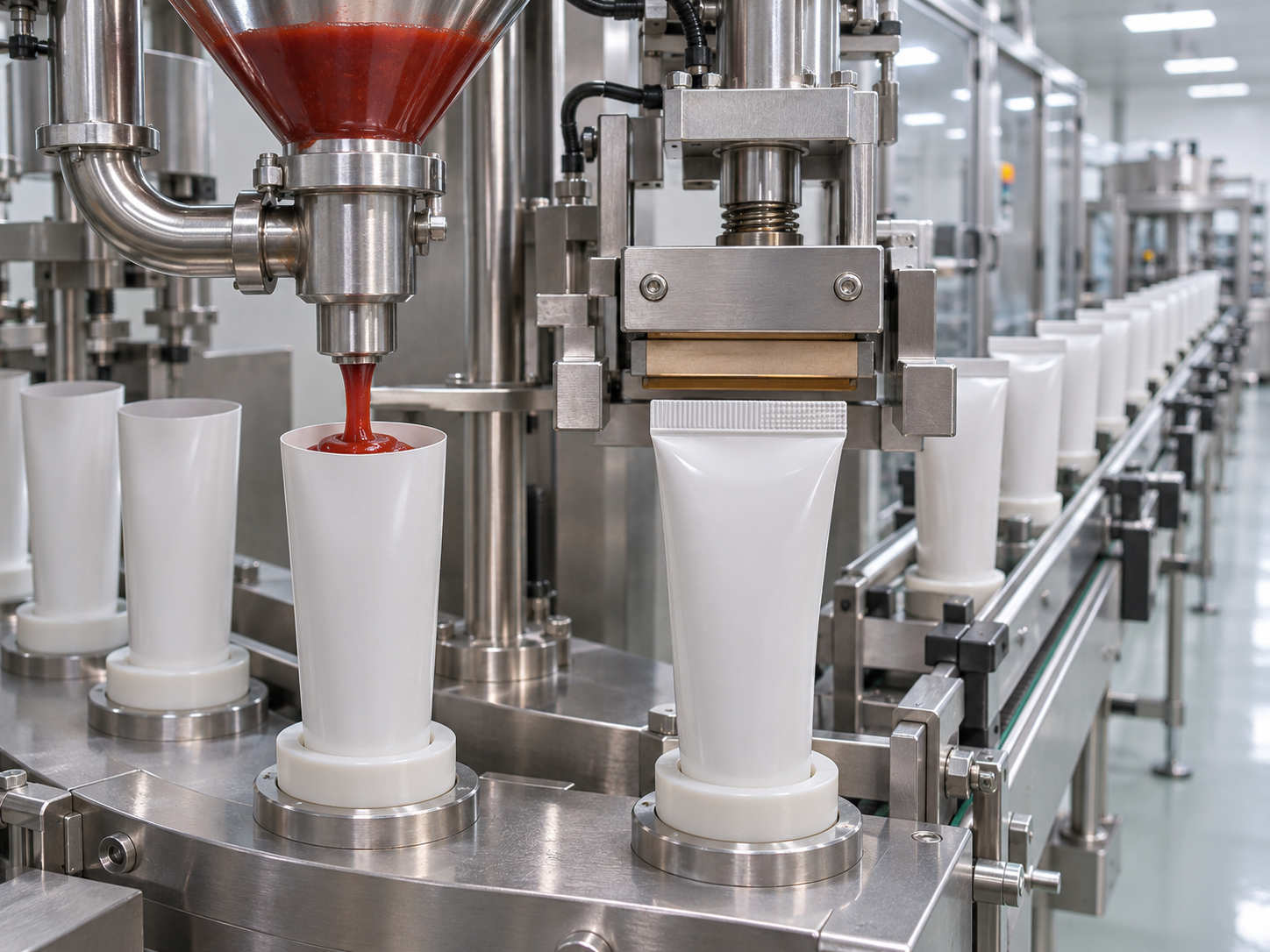
Filling Tomato Paste into ABL Tubes: Seal Quality and Process Checks
Filling tomato paste into laminate tubes demands more than accurate dosing. Product residue near the seal, inconsistent filling temperatures, and poorly controlled sealing settings can all affect package integrity. For operators using a food grade ABL tube for tomato paste, routine checks of fill weight, seal cleanliness, sealing parameters, and finished-tube integrity help identify problems before they lead to leaks or rejected batches. This guide outlines practical process checks to support consistent filling and reliable seal quality.
The challenge is that a tube can look acceptable immediately after sealing and still fail later. A small channel through the seal, an incomplete bond at the edge, or damage to the laminate may only become apparent during handling or storage. A useful inspection routine therefore looks at the process before the seal is made as well as at the finished pack.
Start with the tube, product, and filling process as one system
An aluminum barrier laminate, or ABL, tube combines polymer layers with an aluminum barrier layer. The food-contact layer and the sealant layer are critical to how the tube performs with tomato paste and on the filling line. The aluminum layer provides a barrier, but it does not make every ABL construction interchangeable.
Before a production run, confirm that the supplied tube construction is intended for the product, the filling conditions, and the target market. Relevant questions include whether the tube is suitable for the paste’s acidity, oil or seasoning content, intended shelf life, and any thermal treatment applied after filling. Food-contact suitability should be supported by appropriate supplier documentation for the actual conditions of use; the phrase “food grade” alone is not enough to establish that fit.
The tube also needs to match the machine. Check the diameter, length, shoulder and closure configuration, laminate construction, and open-end dimensions against the approved specification. A change in tube wall or sealant layer can alter the sealing response even when the external dimensions appear unchanged. Treat a material change as a reason to verify the process, not simply to reuse the previous settings.
Keep paste away from the sealing area
Tomato paste is viscous, and its behavior depends on formulation and temperature. A nozzle that strings or drips after dosing can leave a film of product on the inside of the open tube. When the tail is flattened and sealed, that residue may interfere with contact between the sealant layers. The result can be a weak spot or a leak path, even if the outside of the seal looks clean.
Watch the filling action rather than checking only the finished tubes. Is the nozzle positioned as intended? Does it shut off cleanly? Is paste being pulled upward as the nozzle withdraws? A poorly timed nozzle movement, excessive splashing, or unstable product flow can all contaminate the area that must be sealed.
Fill height matters as well. Overfilling leaves less clean material for forming the tail seal and can force paste toward the jaws. Underfilling may cause a net-content failure or create unnecessary headspace. Use the approved fill-weight target and sampling procedure, and check that the fill level leaves the seal area clear under normal production conditions. Net weight and available sealing space are related, but one does not replace the other.
If contamination appears, do not assume that turning up the sealing temperature will solve it. Identify the source first: nozzle shutoff, tube presentation, product level, flow behavior, or another upstream condition. Change one variable at a time where practical, then inspect and test the resulting seals under the site’s approved procedure.
Control product temperature without losing sight of viscosity
A change in paste temperature can change how it flows through the hopper, pump, and nozzle. Operators may notice different dosing behavior, more dripping, or a shift in fill weight before they see an obvious seal defect. Temperature should therefore be checked at the location specified in the production procedure, not inferred from a heater setting alone.
The appropriate filling temperature is product- and process-specific. It must be established with the product formulation, food safety plan, equipment capability, and packaging supplier’s recommendations in mind. A temperature suitable for pumping is not automatically suitable for the tube, closure, or subsequent handling. Likewise, filling temperature should not be treated as proof that the product has received an adequate microbial control treatment.
Record temperature alongside fill-weight and seal observations, particularly after a prolonged stop or when a new batch enters the hopper. These records make it easier to distinguish a sealing-equipment problem from a change in product flow.
Find a reliable sealing window, not a single magic setting
The seal depends on the interaction of heat, pressure, and time, together with jaw condition and tube material. Too little effective heat or pressure can produce an incomplete bond. Excessive heat or pressure can distort the tail, damage the laminate, or weaken the seal. The correct balance depends on the machine and the specific tube construction.
A machine display shows a setting, not necessarily the condition experienced uniformly across every tube. Heater performance, jaw alignment, wear, cooling, and line speed can all influence the result. Confirm that the actual equipment checks required by the manufacturer and the site’s maintenance procedure are being completed, including any applicable temperature verification.
During setup or requalification, establish an approved operating window using representative product, tubes, and production conditions. Assess the full width of the seal, including both edges, rather than judging it from the center alone. Any destructive seal-strength or leak test should follow a documented method with defined acceptance criteria. A test result is only useful when operators know what constitutes a pass and how the sample was prepared.
Pay attention to cooling and handling after sealing. A newly formed seal may be more vulnerable to movement or pressure before it has cooled sufficiently for the process. If tubes are squeezed, dropped, or tightly accumulated immediately after sealing, investigate those conditions as well as the sealing jaws.
Build checks around the points where conditions change
A sound startup check establishes what acceptable production looks like before a large quantity is packed. Examine the first tubes for fill weight, clean tail area, seal position, visible damage, and closure condition. Complete the site’s specified seal-integrity tests before releasing production. Keep an approved reference sample where the quality system permits it, but do not use appearance alone as the acceptance standard.
Routine checks during the run should be frequent enough to detect drift within the site’s quality plan. Extra attention is warranted after events that disturb a stable process:
- A restart after a stoppage, when product temperature, nozzle behavior, or sealing-jaw conditions may have changed.
- A change of tube lot or packaging construction, particularly if seal appearance or machine handling differs.
- A product-batch change, hopper refill, or adjustment to the filling system.
- Maintenance, jaw cleaning, tooling replacement, or a change in line speed.
- A recurring defect, such as paste on the tail, a skewed seal, or unexplained weight variation.
Record the tube lot, product batch, time, relevant settings, test results, and any adjustment made. When a check fails, hold potentially affected product according to the site procedure and work back to the last confirmed acceptable check. The release decision should follow the quality system; a few good tubes produced after an adjustment do not automatically clear earlier production.
Read the defect before adjusting the machine
Different symptoms point to different starting points for investigation. A leak across an apparently formed tail may be associated with contamination or an incomplete bond. A seal that is consistently uneven across its width calls for a closer look at tube alignment, jaw contact, or localized heating. Wrinkling near the tail can indicate that the tube is not presented or flattened consistently before sealing.
Damage elsewhere needs a different investigation. A leak at the closure is not corrected by changing tail-seal temperature. Check the cap, thread or shoulder area, application method, and any specified closure checks. Similarly, a crease or puncture in the tube body may originate in transport, feeding, downstream handling, or excessive mechanical pressure rather than in the seal itself.
Avoid making several adjustments at once. If temperature, pressure, and nozzle timing are all changed together, the immediate defect may disappear without revealing its cause. Document the original condition, make a controlled adjustment within authorized limits, and verify the outcome. Escalate repeated or unexplained failures rather than allowing the process to drift beyond its approved range.
Coordinate packaging and line information before the next run
When discussing a tube issue with a packaging supplier, share more than the tube size. The useful details are the paste formulation characteristics, filling temperature, target weight, sealing equipment and method, observed defect, tube lot, and the checks already performed. Samples of acceptable and defective tubes can also help, provided they are identified and handled under the site’s procedures.
Shanghai Pactek Industries Co., Ltd., established in 2017 and headquartered in Shanghai, supplies laminate packaging solutions and works with manufacturing partners across China. For a tomato paste application, that supply-chain role can support discussions about tube construction, documentation, and customization alongside the requirements of the filling operation. The final choice still needs to be verified against the actual product, equipment, and destination-market requirements.
Before approving a new tube or changing a running specification, agree on the documents and trial quantities needed, the proposed delivery schedule, and who will assess the samples. A controlled line trial, followed by the relevant product and pack evaluations, gives operators a more dependable basis for production than a familiar-looking tube or a borrowed sealing recipe.
Can't find what you're looking for ?
Leave a Message we will call you back quickly!
Product Classification
Professional Service
Interested? Leave your contact details.
Search Starts Here