
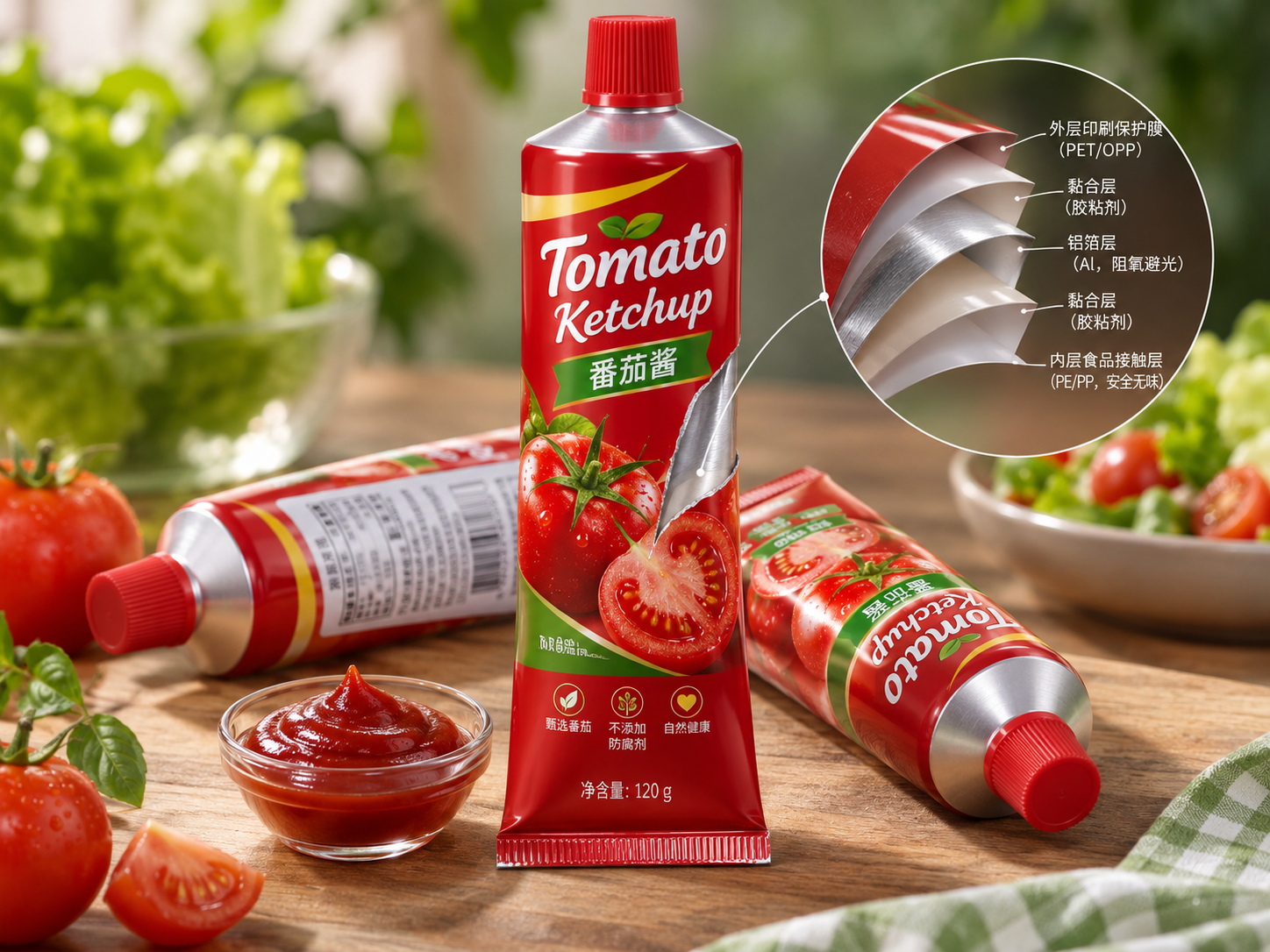
Protecting tomato paste flavor and color requires more than choosing a convenient tube format. Oxygen exposure, light, product acidity, filling conditions, and the way consumers use the pack can all influence the result over shelf life. A food grade ABL tube for tomato paste combines an aluminum barrier layer with polymer layers, but the presence of aluminum alone does not establish that a finished tube is fit for purpose.
For technical evaluators, the decision is about the entire packaging system: laminate, seams, shoulder, nozzle, closure, filling process, and storage conditions. Each component can affect whether the paste reaches the consumer with the expected color and flavor.
What the aluminum barrier does—and what it does not do
Aluminum barrier laminate, or ABL, generally consists of a thin aluminum layer bonded between polymer layers. The aluminum provides a strong barrier to oxygen, moisture vapor, and light when it is continuous and properly protected. The surrounding polymers contribute functions such as sealing, mechanical protection, print support, and contact with the product.
That arrangement is relevant to tomato paste because the product’s color and sensory qualities can change during storage. Oxidative reactions can affect flavor and appearance, while light exposure may accelerate certain quality changes. The paste itself, its residual oxygen content, processing history, and storage temperature also matter. Packaging is one part of the preservation strategy, not a substitute for product formulation and process control.
The laminate’s barrier performance should therefore be assessed alongside the finished tube’s performance. Oxygen can enter through routes other than the broad laminate surface, including the closure interface, shoulder, seams, or damaged areas. A highly protective web does not compensate for a poorly sealed pack.
Start with the product and process, not a standard structure
Before comparing laminate options, document the tomato paste and the conditions the tube will encounter. A concentrated paste filled at ambient temperature presents a different challenge from a hot-filled product or a formulation containing oil, salt, spices, or other ingredients. Acidity, viscosity, water activity, and intended shelf life may all influence the evaluation plan.
Share the following information with prospective suppliers early in the discussion:
- Product characteristics: formulation, acidity or pH, relevant ingredients, and any known sensitivity to oxygen, light, or packaging odors.
- Filling conditions: product temperature, filling speed, headspace, and whether air is displaced before sealing.
- Post-fill treatment: any heating, cooling, or other process applied to the sealed pack.
- Distribution conditions: expected storage temperatures, transport stresses, and retail display exposure.
- Use pattern: anticipated time between opening and final use, dispensing frequency, and storage instructions after opening.
These details help narrow the choice of inner polymer, sealant, adhesive system, and tube construction. They also prevent a common procurement problem: approving a material based on a generic food application, then discovering that the actual filling process falls outside the conditions supporting its suitability.
Assess barrier performance at three levels
1. The laminate web
Request the proposed layer structure and relevant barrier test information for the laminate. Ask how oxygen and moisture transmission were measured, including the test method, temperature, and relative humidity. Values measured under different conditions are not directly comparable, and a specification for a flat web should not be presented as a finished-pack result.
The aluminum layer is also important for light protection. Its contribution depends on its continuity and the condition of the laminate after converting and handling. Creasing, flexing, or damage can create defects, so barrier claims should be considered together with mechanical testing appropriate to the tube’s expected use.
2. The converted tube
A tube undergoes forming, shoulder attachment, and sealing operations that introduce interfaces absent from a flat material sample. Examine the longitudinal seam, shoulder-to-body joint, nozzle area, and closure fit. Request information on the construction and quality controls used at these points, then verify performance on representative finished packs.
For a tomato paste application, testing should include seal integrity and leakage under conditions relevant to filling, transport, and dispensing. The appropriate methods depend on the pack design and equipment. Visual inspection is useful, but it cannot establish barrier integrity on its own.
3. The filled and used pack
Headspace oxygen and dissolved oxygen introduced during processing can affect quality even when the tube has an effective barrier. Evaluate the filled pack as a system: measure relevant initial conditions, follow product quality during storage, and investigate any changes alongside packaging results.
Repeated squeezing and recapping deserve attention too. A tube may be opened many times before the paste is consumed. Check whether the closure remains cleanable and secure, whether product accumulates around the nozzle, and whether normal dispensing causes leakage or damage. Performance after opening is a separate question from unopened shelf life.
Food-contact suitability: ask for conditions, not just a label
“Food grade” is a useful starting description, but it is not a complete compliance assessment. For a food grade ABL tube for tomato paste, request documentation that identifies the applicable regulations in each intended market and the materials covered. The assessment should reflect the actual food type, contact duration, temperature, and any thermal treatment.
The food-contact layer, closure components, and any other surfaces that may contact the paste should be included. Depending on the structure and applicable requirements, supporting information may also be needed for adhesives, inks, and other constituents. Ask whether migration testing or other compliance work is relevant to the intended use, and confirm the conditions and food simulants used where testing is supplied.
Do not assume that a declaration for laminate web automatically covers every component of a converted tube. Clarify who is responsible for the compliance documentation for the laminate, shoulder, cap, and finished assembly. Supplier documents support the assessment, but the brand owner or packer should verify that the final application is within their stated scope.
Compatibility with acidic paste and sealing operations
The inner layer separates the tomato paste from the aluminum and other non-contact layers. Its selection should account for the product formulation, contact temperature, and intended shelf life. Ask the supplier about the proposed material’s suitability, then validate it with the actual paste. Watch for changes in odor, taste, appearance, delamination, or the integrity of the product-contact surface during storage.
Sealability is equally important. A suitable sealant layer must work with the filling line’s sealing equipment and the chosen operating window. Temperature, pressure, dwell time, and cooling can affect seal quality; contamination from paste in the seal area can make a nominally acceptable structure unreliable in production.
Run trials across the anticipated production range rather than approving only the best-looking sample. Check seal strength where appropriate, but interpret it alongside leak and integrity results. A strong seal is not necessarily a continuous seal, and a tube that passes an initial test should still be checked after handling and storage.
Compare candidates with a decision matrix
When several ABL tube proposals look similar, a structured comparison makes the trade-offs visible. Record both the evidence supplied and the evidence still needed before qualification.
Keep procurement considerations in the matrix as well: available tube dimensions, decoration requirements, supply arrangements, and change control can affect implementation. A material change after approval—including a different polymer, adhesive, closure, or manufacturing location—should trigger an assessment of whether existing qualification evidence remains valid.
Build a practical qualification plan
Begin with samples representative of the proposed commercial construction, including the intended cap and shoulder. Fill them with the actual tomato paste using conditions as close as practical to the production process. Include a suitable reference pack if one is available, so that observed product changes can be interpreted in context.
Set acceptance criteria before the trial. Depending on the product and available methods, these may include color and sensory attributes, package integrity, seal performance, and observations of the contact layer. Include expected storage conditions and relevant excursions; accelerated testing can help screen options, but it should not be treated as a substitute for evidence under the intended shelf-life conditions.
Review results at agreed intervals rather than waiting until the end. If flavor or color changes, investigate product processing, initial oxygen, storage conditions, and pack integrity together. That approach avoids attributing every quality issue to the laminate—or overlooking a packaging defect because the material data sheet looked reassuring.
Shanghai Pactek Industries Co., Ltd. provides laminate tubes and related laminate materials through a network of manufacturing partners in China. For an evaluation, a useful starting point is to share the formulation requirements, target markets, filling conditions, and desired tube configuration so that potential structures and the documentation needed for assessment can be discussed. The final selection should rest on application-specific testing of the complete filled pack.
Can't find what you're looking for ?
Leave a Message we will call you back quickly!
Product Classification
Professional Service
Interested? Leave your contact details.
Search Starts Here