
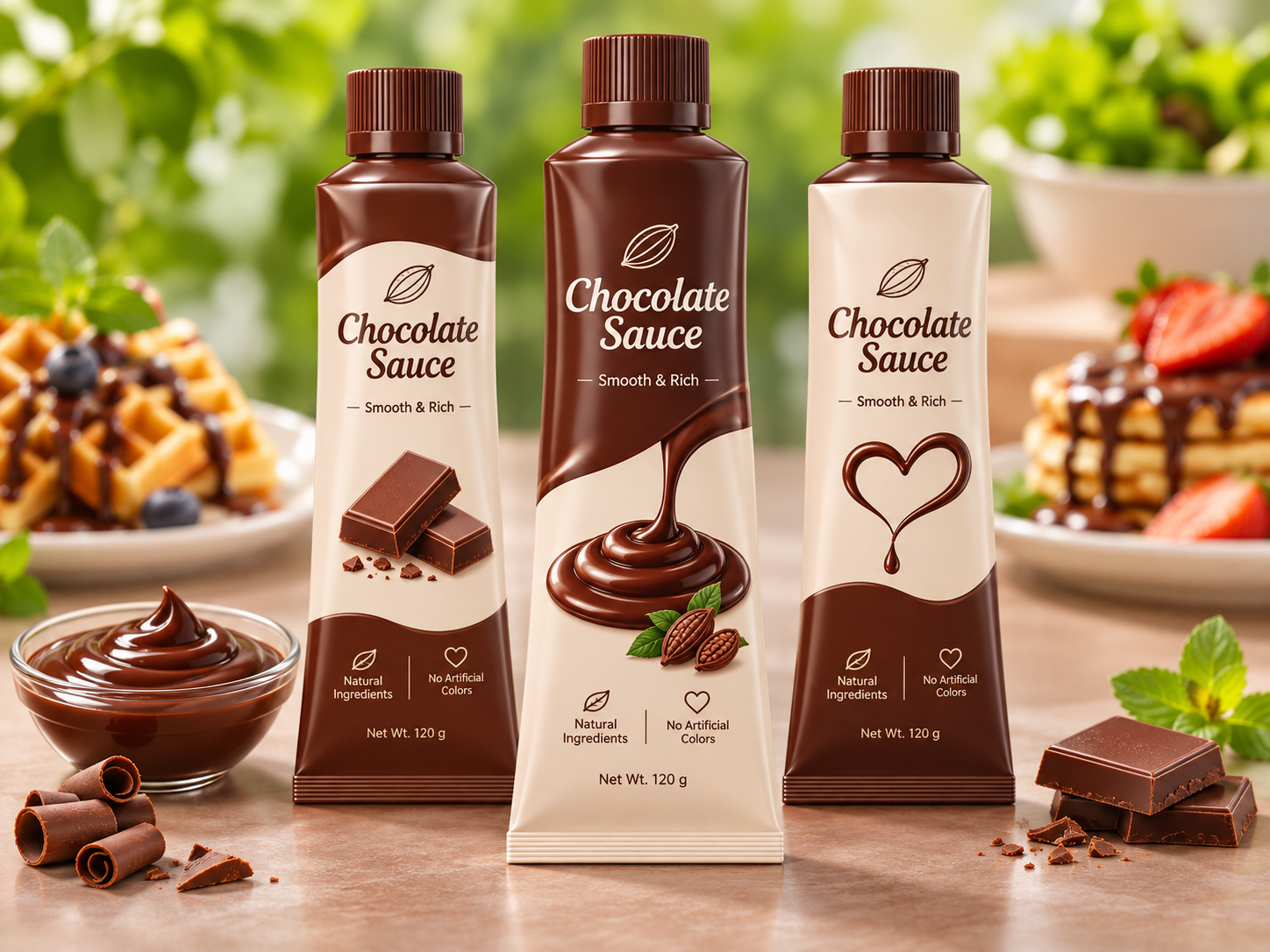
A food grade ABL tube for chocolate spread should be selected as a complete packaging system, not on the strength of its aluminum layer alone. The laminate must provide an appropriate barrier, the product-contact surfaces must be suitable for a fatty food, and the shoulder, closure, seams, and filled-end seal must remain secure through production and distribution.
This distinction matters when a spread fills cleanly during a trial but later develops an off-flavor, leaks around the cap, or leaves product in the sealing area. Start by defining the formulation, filling conditions, intended shelf life, and distribution environment. Then evaluate candidate tube constructions against those conditions using filled-pack testing rather than relying on a material description alone.
Start with the spread and the process
Chocolate spread is not a single packaging challenge. Recipes differ in fat composition, particle content, viscosity, aroma profile, and sensitivity to temperature. A smooth spread that flows readily at the filling nozzle may behave differently from a formulation containing nut particles or one that thickens significantly as it cools.
Before asking for tube samples, document the conditions that will determine whether the pack can be filled and used consistently:
- Formulation: identify relevant fats, flavor ingredients, particles, and any ingredients that may interact with the contact layer.
- Flow behavior: record viscosity or other flow measurements at the temperatures and shear conditions relevant to filling, where available.
- Thermal profile: establish expected product temperature at filling, cooling conditions, and the temperature range during storage and transport.
- Pack use: define the target fill quantity, dispensing expectations, closure type, and whether the product is intended to be consumed over multiple openings.
- Line constraints: identify tube orientation, filling method, sealing equipment, available tooling, and the range of tube dimensions the line can handle.
These inputs help distinguish a material problem from a process problem. For example, a tube that is difficult to dispense may have a body that is too stiff for the intended user, but the spread’s low-temperature viscosity or a restricted nozzle may be equally important.
Assess the barrier as part of the finished tube
Aluminum barrier laminate typically combines an aluminum layer with polymer layers. The aluminum contributes to protection against oxygen, moisture, and light, while the polymer layers provide functions such as product contact, sealing, and mechanical support. Exact construction varies, so request the proposed layer structure and the intended function of each layer rather than assuming all ABL tubes perform alike.
For chocolate spread, oxygen exposure is relevant because oxidation of fats can contribute to undesirable flavor changes. Aroma retention and protection from external odors may also influence sensory quality. Moisture transfer can matter, but its importance depends on the formulation and the surrounding environment; it should not automatically be treated as the dominant shelf-life mechanism.
A strong barrier in a flat laminate does not guarantee equivalent protection from the assembled pack. The longitudinal seam, shoulder joint, closure interface, and filled-end seal can create different routes for leakage or gas exchange. Mechanical damage, folding, or deformation during handling may also compromise local performance. Ask whether available barrier data relate to the laminate, the empty tube, or the closed, filled pack, and compare results only when test conditions and sample configurations are understood.
Translate barrier data into a shelf-life question
Request oxygen and water-vapor transmission information where available, including the test method, temperature, humidity, and sample construction. A figure without those conditions is difficult to compare across materials. Extremely low film transmission values should also be interpreted alongside the practical sensitivity and limits of the test method.
Use the information to screen candidates, not to declare a shelf life. The acceptance criterion should be based on the product’s sensory and quality requirements over the intended storage period. A representative study should include the actual formulation and final closure, with samples assessed for appearance, odor, flavor, and other product-specific quality attributes. Include distribution stresses where they could affect the pack. Accelerated storage can help identify differences, but its relationship to normal storage must be established before using it to predict shelf life.
Check food contact and formulation compatibility
The inner polymer layer is in direct contact with the spread; the shoulder and closure may also contact the product. Each relevant component should be assessed for the intended food, contact duration, temperature, and market. A general statement that a material is “food grade” is a starting point, not a complete technical justification.
Request current food-contact documentation covering the actual components and intended conditions of use. Establish which party is responsible for assessing the assembled packaging and whether supporting information covers fatty foods, elevated filling temperatures, and long-term storage where applicable. Regulatory requirements depend on the destination market. Declarations and test results should be reviewed against that market and the actual use conditions rather than treated as universally interchangeable.
Compatibility also includes effects that compliance paperwork alone may not resolve. Fat can interact with some materials, while packaging components can affect odor or flavor. Store the filled tube in representative orientations, including contact with the shoulder and closure where relevant, and examine the product and pack over time. Compare the spread against an appropriate control so that formulation changes can be separated from packaging-related changes.
Discuss the complete construction with the supplier, including inks, adhesives, and other materials where relevant to the food-contact assessment. Do not assume that the aluminum layer eliminates every migration or sensory concern: exposed edges, joints, and other components remain part of the finished package.
Match tube geometry to filling and dispensing
Tube diameter, length, shoulder shape, and nozzle opening affect both line performance and consumer use. A larger opening can help a viscous spread dispense, but it may alter dosing control or increase the amount of product left around the closure. A narrower opening may be suitable for a smoother formulation, yet require excessive squeezing force when the product is cool.
Assess usable capacity rather than nominal volume alone. The required fill quantity, product density at filling temperature, and headspace determine the occupied volume. Additional unfilled tube length must be available for a clean, correctly formed end seal. Too little space can cause product contamination of the seal or distort the tube during crimping; too much headspace can affect pack appearance and leave more oxygen inside.
Tube stiffness is another trade-off. A body that holds its shape well may be less comfortable to squeeze and may retain more product after use. A softer construction may dispense more easily but require closer attention to handling and presentation. Evaluate filled tubes at the lowest realistic use temperature as well as at normal room conditions, because a spread that is easy to dispense when warm may behave differently after cooling.
Qualify filling and sealing together
Filling temperature should be high enough to provide stable flow without exceeding limits established for the product, packaging components, or equipment. There is no universal temperature for chocolate spread: fat behavior, particle suspension, and viscosity must be considered alongside tube and closure compatibility. Confirm the product temperature at the nozzle, not just the temperature in the holding vessel, and observe whether it changes during a production run.
Run trials at representative line speed and fill weight. Watch for splashing, stringing, air entrainment, inconsistent fill, and residue on the area that will become the tail seal. Nozzle position and withdrawal, fill rate, and product temperature can all affect cleanliness. A tube that seals well when manually filled may fail on an automatic line if the nozzle leaves a thin film of fat or spread across the sealing surface.
Set the heat-sealing process for the actual laminate and equipment. Sealing conditions involve temperature, pressure, and dwell time, but the acceptable window depends on the inner layer, tube geometry, tooling, and line speed. Excessive heat can distort or damage the tube; insufficient heat or pressure can leave a weak or incomplete seal. Use the tube supplier’s starting guidance where available, then establish a controlled operating window through trials.
Inspect seals across startup, steady production, and foreseeable stops and restarts. Assess seal appearance and dimensions, then use suitable seal-strength and leak tests on representative samples. Visual inspection alone cannot establish that a seal is sound. Any destructive test needs agreed acceptance criteria and sampling, including how results will be interpreted for the finished pack.
Look beyond the tail seal
A satisfactory crimp does not rule out leakage elsewhere. Check the shoulder-to-body joint, longitudinal seam, nozzle, closure engagement, and any induction liner or other seal if the design includes one. Closure torque or application settings should be assessed against the actual closure design; overtightening can be as unhelpful as inadequate engagement. Test filled packs after handling and temperature exposure, not only immediately after filling.
Build a qualification plan that separates risks
A practical evaluation moves from documentation to controlled trials and then to filled-pack storage. This order avoids spending months on a candidate that cannot run on the line, while ensuring that short-term production success is not mistaken for shelf-life evidence.
- Screen the construction. Review layer structure, food-contact documentation, dimensions, barrier data, closure details, and the supplier’s recommended processing limits against the intended application.
- Check fit on equipment. Confirm tube handling, orientation, nozzle access, filling clearance, sealing tooling, and finished-pack dimensions. Use representative samples rather than relying only on drawings.
- Run the actual spread. Trial realistic filling temperatures, fill quantities, speeds, and stop-start conditions. Record settings and observations so that differences between candidates can be traced to a cause.
- Challenge integrity. Assess seals and closures before and after relevant transport simulation, compression, temperature exposure, or other stresses defined for the distribution route.
- Monitor stored product. Evaluate filled packs throughout the intended shelf-life study for sensory changes, leakage, appearance, dispensing, and any other agreed quality measures.
Agree on pass or fail criteria before testing. These can include an acceptable fill range, seal and leak-test results, sensory limits, and dispensing performance. Specify sample quantities and test intervals appropriate to the risk and the decision being made. A few successful samples can support an initial screening decision, but they do not establish production consistency or long-term performance.
When a candidate fails, trace the failure before changing materials
Off-flavor or aroma loss calls for a review of the formulation, residual oxygen in the headspace, closure integrity, and storage conditions as well as laminate barrier data. Compare sealed-pack performance with the control and inspect whether the problem appears across all samples or only in damaged or poorly sealed ones.
Leaking at the filled end directs attention first to seal contamination, sealing settings, alignment, and tooling condition. Examine failed seals for product residue or incomplete bonding before concluding that the laminate is unsuitable. Repeat testing after process adjustments under normal line conditions.
Hard dispensing or inconsistent filling may point to product temperature, viscosity, particle size, nozzle geometry, or tube stiffness. A wider nozzle or different tube construction can help in some cases, but changes should be checked against closure fit, dosing behavior, line compatibility, and the required barrier performance.
The decision is ready for approval only when the documented construction, filling settings, integrity results, and storage evidence all describe the same intended pack. If the formulation, supplier, tube structure, closure, or process changes afterward, assess which parts of the qualification need to be repeated; a previous result may no longer cover the altered configuration.
Can't find what you're looking for ?
Leave a Message we will call you back quickly!
Product Classification
Professional Service
Interested? Leave your contact details.
Search Starts Here