
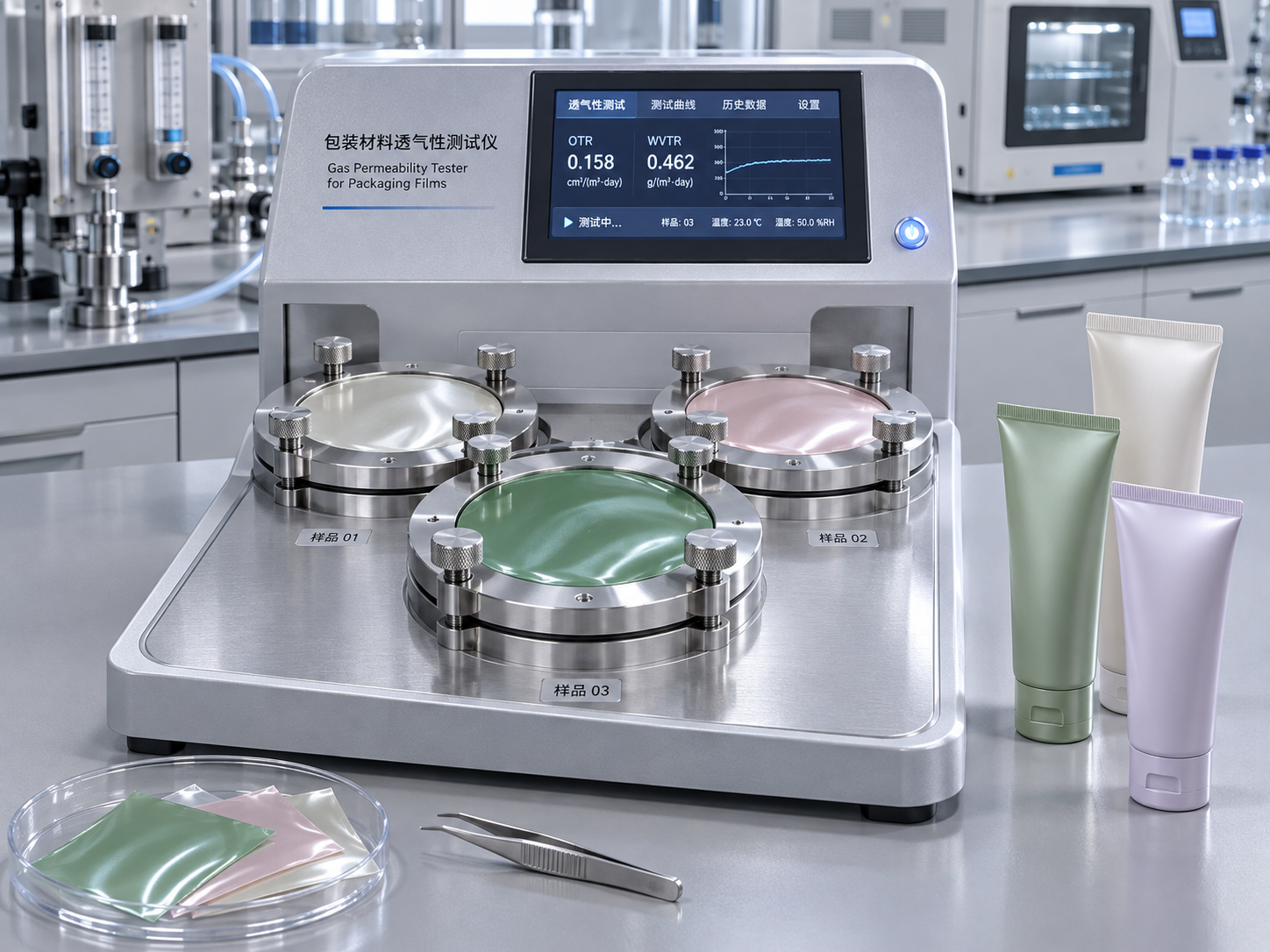
Can recyclable laminate web provide enough barrier protection for cosmetics? The answer depends on the formulation, packaging structure, and required shelf life. To make informed material choices, brands should request relevant oxygen and water vapor transmission data, along with testing conditions and evidence of compatibility with their products. This guide explains which barrier data to ask for and how to evaluate recyclable cosmetic laminates without compromising product quality.
Can a recyclable laminate protect a sensitive cosmetic formula?
It can, but “recyclable” is not a barrier specification. A laminate designed for recycling may use a polyolefin-based structure with a barrier layer or coating, while another may rely mainly on the properties of its base polymers. Their oxygen and moisture performance can differ substantially, even if both are described as recyclable.
The right question is whether the complete pack keeps a particular formula within its quality limits throughout distribution, storage, and use. An oxidation-sensitive facial oil may need a different oxygen barrier from a rinse-off cleanser. A water-rich cream may be more concerned with moisture loss, viscosity change, or preservative performance. A fragrance-heavy product may present an additional challenge: retaining volatile ingredients and preventing the packaging from absorbing or altering them.
Start with the failure you are trying to prevent, not with a material label. Then ask the supplier for data that addresses that failure.
Which barrier measurements should be on the request list?
Oxygen transmission rate
Oxygen transmission rate, or OTR, indicates how much oxygen passes through a material under specified test conditions. It is particularly relevant when a formula contains ingredients susceptible to oxidation, or when color and odor changes are among the brand’s stability concerns.
Ask for the result for the complete laminate structure, not just the barrier resin or coating. Request the units, test method, temperature, relative humidity, and the oxygen conditions used. A typical film result may be reported as a volume of oxygen per unit area and time, but units and pressure conditions must be checked before comparing quotations.
Humidity deserves particular attention. Some barrier materials are more sensitive to moisture than others, so a dry-condition result may not represent performance in a humid supply chain. If the intended market has challenging storage conditions, discuss whether additional testing at relevant humidity is warranted.
Water vapor transmission rate
Water vapor transmission rate, or WVTR, measures the passage of water vapor through the material under defined conditions. For a water-based cosmetic, moisture loss can change texture or concentration; for a moisture-sensitive product, ingress may be the greater concern.
Request the result with its units, temperature, relative humidity conditions on both sides of the specimen, and test method. WVTR is often expressed as mass per area per time. A result measured under one set of conditions should not be treated as directly equivalent to a result measured under another.
For both OTR and WVTR, ask whether the reported number is a typical value, a range, or a specification limit. Those are different things. A typical result is useful for screening, but it does not by itself establish what will be accepted from every production batch.
Light and volatile-component protection
A low OTR does not tell you whether a laminate protects a light-sensitive formula. If light exposure matters, request light transmission data across the relevant wavelengths for the actual printed or unprinted structure. Color and opacity can help, but visual appearance is not a substitute for a measurement.
Likewise, oxygen and water vapor results do not predict every fragrance or solvent loss. Depending on the formula, a brand may need a specific permeation or retention study using representative ingredients or, preferably, the finished product. This is especially useful when a product’s scent is part of its identity: a pack can pass routine appearance checks and still produce an unacceptable odor change.
What details make supplier data comparable?
Two data sheets can show different numbers without proving that one laminate is better. Before making a selection, check that the results describe comparable structures and test conditions. Ask suppliers to identify:
- The layer construction, including the barrier layer or coating and nominal thicknesses where commercially available.
- The total laminate thickness and whether the sample was printed, coated, or otherwise converted before testing.
- The test method and laboratory conditions, including temperature, humidity, and relevant gas or pressure conditions.
- Whether the result comes from the proposed production structure, a development sample, or a related material.
- The basis of the value: typical result, measured range, or agreed specification limit.
Common methods include ASTM D3985 for oxygen transmission and ASTM F1249 for water vapor transmission. The method designation alone is not enough: the reported conditions and sample construction still matter. Ask for the underlying report when a data sheet leaves those details unclear.
Be cautious with a particularly attractive number that applies only to a thicker grade, a different coating, or an unprinted laboratory sample. Before approval, the supplier should confirm that the tested structure matches what will actually be purchased.
Is film data enough to predict shelf life?
No. Film data helps screen materials, but a cosmetic is sold in a package, not in a flat test specimen. A tube or pouch also has seals, folds, and potential weak points. Tubes add components such as the shoulder and closure; pouches depend heavily on seal design and process control. Filling and converting can introduce creases or stresses that affect the finished structure.
Ask what finished-pack testing is appropriate for the format. Depending on the project, that may include seal integrity, leakage, transport simulation, and barrier assessment after relevant converting or flexing. The objective is not to order every possible test. It is to identify how the pack could fail in the intended supply chain.
A useful comparison keeps the intended pack size and geometry in view. A small amount of permeation through a larger surface area may have a different effect on a small fill than on a larger one. Headspace, closure performance, filling conditions, and the formula’s oxygen sensitivity also influence the result. There is no universal OTR or WVTR number that guarantees a given cosmetic shelf life.
What compatibility evidence should brands request?
Barrier testing and compatibility testing answer different questions. Barrier data describes transmission through a material under controlled conditions. Compatibility work examines what happens when the actual formulation and package spend time together.
For a tube, ask whether the product-contact layer has been assessed with formulations of a similar type, and use that information to plan testing with your own formula. Depending on the product, watch for swelling, softening, discoloration, seal changes, odor transfer, ingredient absorption, or changes in appearance and performance. Relevant extractables or migration questions should be assessed with qualified specialists against the intended product and market requirements; a general statement of material suitability is not a substitute for that assessment.
Run the stability program in representative finished packs, including the intended closure. Accelerated storage can help identify risks, but its results need interpretation alongside real-time studies. The brand should define acceptable changes before testing begins, so the discussion at the end is not simply whether a sample “looks fine.”
How should barrier performance be weighed against recyclability?
There is usually a trade-off to investigate, not a choice between “high barrier” and “recyclable.” Barrier coatings, layer proportions, inks, adhesives, closures, and labels can all affect how a finished pack is assessed. A structure that performs well in a material screening may still face collection, sorting, or recycling limitations in a particular market.
Ask what design guidance or assessment supports the recyclability claim, which complete pack configuration was evaluated, and where the claim is intended to apply. Separate a supplier’s design intent from evidence of practical collection and recycling. Requirements and infrastructure vary by market and can change, so claims need checking against current local rules and guidance.
If the first recyclable candidate falls short on barrier, do not immediately abandon it or add a barrier layer without further review. Consider whether a different coating, pack size, closure, filling process, or shelf-life target could solve the problem. Each change needs to be checked against both product protection and the recyclability assessment.
What should go into a supplier inquiry?
Give the supplier enough context to make a useful recommendation: product type, known sensitivities, target shelf life, proposed tube or pouch dimensions, filling process, destination markets, and expected storage conditions. Share any required recyclability criteria and whether the pack will be printed. If formulation details are confidential, a nondisclosure agreement can make a more meaningful technical discussion possible.
Then request a documented structure, comparable OTR and WVTR data, relevant light or volatile-retention information, and a plan for compatibility and finished-pack evaluation. Also agree on which properties will become production specifications and how material changes will be communicated after approval.
Shanghai Pactek Industries Co., Ltd. works with laminate webs, films, tubes, and pouches through its packaging supply network. For a brand comparing structures across suppliers, a practical starting point is to align the data request before samples are ordered. That makes it easier to distinguish a promising material from one that merely comes with an impressive, but not directly comparable, barrier number.
Can't find what you're looking for ?
Leave a Message we will call you back quickly!
Product Classification
Professional Service
Interested? Leave your contact details.
Search Starts Here