
Sourcing food grade ABL tube wholesale packaging involves more than comparing unit prices. A purchasing team may find a promising quote, only to discover that the minimum order quantity applies to each artwork version, the production clock starts after sample approval, or the food-contact documents do not cover the intended market.
These details matter when a food launch depends on packaging arriving in time for filling. Use the following checklist to compare aluminum barrier laminate tube offers on the same basis, understand where costs can accumulate, and build a delivery schedule that leaves room for decisions.
Start with the tube specification, not the quoted quantity
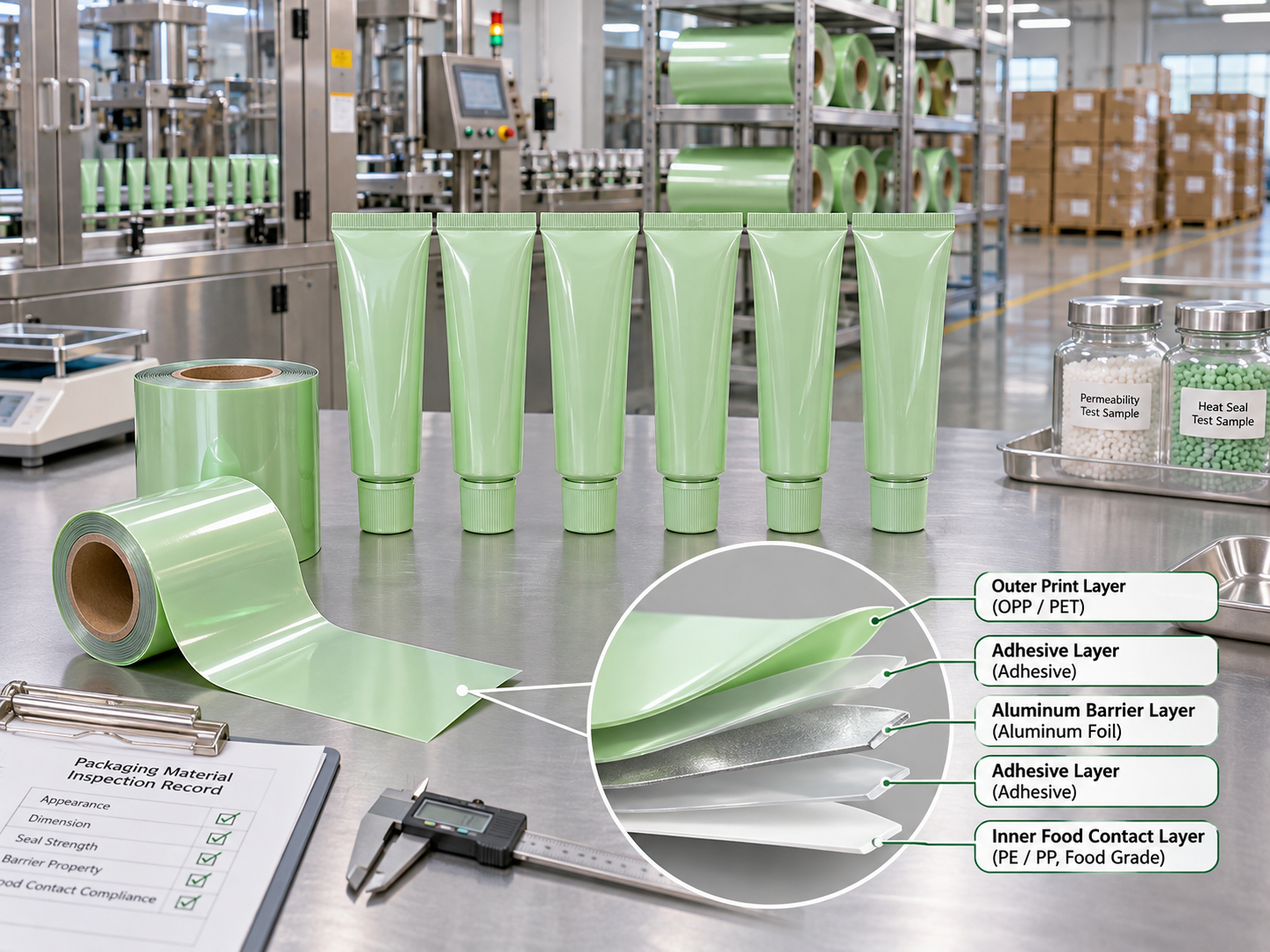
An ABL tube is made from a laminate structure that includes an aluminum barrier layer. The structure can help protect a packaged product from external influences, but its suitability depends on the complete material construction, closure, food formulation, and intended shelf life. An ABL tube is not automatically suitable for every food application simply because it contains an aluminum layer.
Before requesting prices, give suppliers enough information to identify an appropriate construction. A useful enquiry includes:
- The food product, including relevant characteristics such as acidity, oil content, and any strong flavors or aromas.
- Target fill volume, tube diameter and length if known, and expected headspace.
- Filling conditions, sealing method, storage temperature, and anticipated distribution environment.
- Required closure type, opening characteristics, dispensing needs, and any tamper-evidence requirements.
- Destination markets, desired shelf life, and the documentation needed for the intended food-contact use.
If your team has not selected dimensions, share the target fill volume and filling equipment constraints instead of guessing. Suppliers can propose options, but the final choice should be checked through filling, sealing, compatibility, and shelf-life assessment as appropriate.
MOQ: identify what the minimum actually applies to
The minimum order quantity is often the first number a buyer asks for, but it is also one of the easiest to misunderstand. A supplier may quote a minimum for a tube size, a production run, a printed design, a color variation, or a combination of these. A total quantity that looks manageable can become less attractive when divided among several flavors or language versions.
Ask these questions before comparing offers
- Is the MOQ calculated per order, tube specification, artwork, SKU, or delivery batch?
- Can several designs share one production run, and under what conditions?
- Does a different cap color or closure change the minimum quantity?
- Are unprinted, stock, or less customized options available at a different MOQ?
- Is there a permitted overproduction or underproduction tolerance, and how will it be invoiced?
- Can a repeat order use the same approved materials and artwork, subject to availability?
For a new product with uncertain demand, a smaller order may reduce inventory exposure even if its unit price is higher. For an established food line, a larger run may be more economical, provided the business can use the stock before packaging specifications, branding, or regulatory text change.
Do not assume split deliveries solve the whole problem. Ask whether the supplier can hold finished stock, how storage is charged, when ownership transfers, and whether the full quantity must be paid for upfront. A delivery schedule is useful only when the commercial terms behind it are clear.
Build a lead-time plan around approval milestones
“Production lead time” rarely describes the entire journey from enquiry to usable tubes at your filling site. It may exclude artwork preparation, sampling, document review, freight, customs clearance, or local delivery. Ask for each stage separately and confirm the event that starts the supplier’s clock.
Work backward from the date the tubes must be available for filling—not merely from a planned launch date. Allow time for internal approvals and potential corrections. If the artwork includes several languages or mandatory food labeling, coordinate with the relevant regulatory and brand teams before giving final approval.
For a repeat order, ask whether the supplier’s estimate assumes unchanged artwork, tooling, materials, and specifications. A revised ingredient statement or new closure can turn a straightforward reorder into a fresh approval process.
Check food-contact documentation against the actual application
“Food grade” is a useful starting phrase, not a complete purchasing specification. The documents you need depend on where the food will be sold, the parts that contact it, the type of food, and the conditions of use. Tell the supplier the intended markets and application early, then have your quality or regulatory team determine what evidence is sufficient.
Request documentation for the relevant components and construction, including the product-contact layer and closure where applicable. Ask whether declarations identify the material, intended conditions of use, and any restrictions. Where migration testing or supporting information is needed, confirm how the test conditions relate to your food type, storage time, and temperature.
A certificate or declaration for a raw material does not automatically establish compliance for the finished package in every application. Clarify who is responsible for assessing the complete tube-and-closure system and whether additional testing is required. Keep the approved documents linked to the exact specification and version being purchased.
Compare total landed cost, not just the tube price
A low unit quote can be misleading when artwork, tooling, freight, or quality requirements are priced separately. Ask suppliers to show the commercial assumptions behind their offer so that each quotation covers a comparable scope.
- Tube and closure: Confirm whether caps, liners or other specified components are included.
- Artwork and setup: Identify charges for plates, cylinders, tooling, proofs, revisions, or new designs, where applicable.
- Samples and testing: Check charges for custom samples, shipping, and any agreed testing.
- Freight and delivery: Confirm the trade term, named location, packing method, and which party handles customs and import costs.
- Order quantity: Compare price breaks alongside MOQ, production tolerance, and the cost of holding unused stock.
- Payment terms: Understand deposit, balance, currency, and any conditions for repeat orders or stored inventory.
For internal comparison, calculate the expected cost of getting an acceptable tube to the filling site, then consider the inventory risk separately. A larger order may lower the quoted unit price while increasing cash tied up in stock. The right balance depends on forecast confidence and the likelihood of packaging changes.
Samples: know what has—and has not—been approved
A sample can answer several different questions, but one sample does not necessarily answer them all. An existing tube may help check size and handling. A printed proof may show artwork placement. A custom pre-production sample may be closer to the intended specification, though procurement should still confirm which materials, closure, decoration, and manufacturing processes it represents.
Before signing off, involve the people who will use the packaging. The filling team may need to check tube feeding, filling, sealing, and finished-pack handling. Quality colleagues may need to assess seals, dispensing, leakage, and compatibility with the food product. The brand team should review print content and appearance against the approved artwork.
Record the sample version, approval date, and any agreed deviations. If a requirement is critical, put it in the purchase specification rather than relying on a conversation or an unlabelled sample.
Questions to settle before issuing the purchase order
A practical purchase order should connect the commercial offer to the approved technical details. Before release, check that both sides agree on:
- The tube structure, dimensions, capacity reference, closure, decoration, and artwork version.
- The quantity per SKU, applicable MOQ, permitted quantity tolerance, and price basis.
- The sample or proof that serves as the approval reference, plus any agreed quality criteria.
- The food-contact documents to be supplied and the markets and conditions they address.
- The production start trigger, dispatch target, delivery term, and escalation process for changes or delays.
- Packing, labeling, batch identification, inspection arrangements, and the procedure for reporting nonconformities.
Also agree on how changes will be managed. If a material, closure, or production location changes after approval, determine whether advance notice, document review, or renewed testing is required. This is especially important when the packaging forms part of a controlled food safety and quality system.
Choosing a sourcing partner for food grade ABL tube wholesale orders
Some buyers already know the exact tube structure and need a supplier to quote against it. Others need help coordinating options across materials, tube formats, and customization requirements. In either case, a useful sourcing partner should be able to clarify what is included, relay technical questions, and keep the quotation aligned with the approved specification.
Shanghai Pactek Industries Co., Ltd. supplies laminate packaging solutions and works with manufacturer partners across China. Its portfolio includes laminate tubes and laminate materials used in food and other packaging applications. For an enquiry, procurement teams can share their intended food use, destination markets, estimated quantities, artwork requirements, and target delivery date to support a more meaningful assessment of available options.
The strongest purchasing decision is not necessarily the offer with the lowest MOQ or shortest stated production time. It is the one whose quantities, documentation, approvals, costs, and delivery responsibilities are clear enough to support the actual production plan.
Can't find what you're looking for ?
Leave a Message we will call you back quickly!
Product Classification
Professional Service
Interested? Leave your contact details.
Search Starts Here