
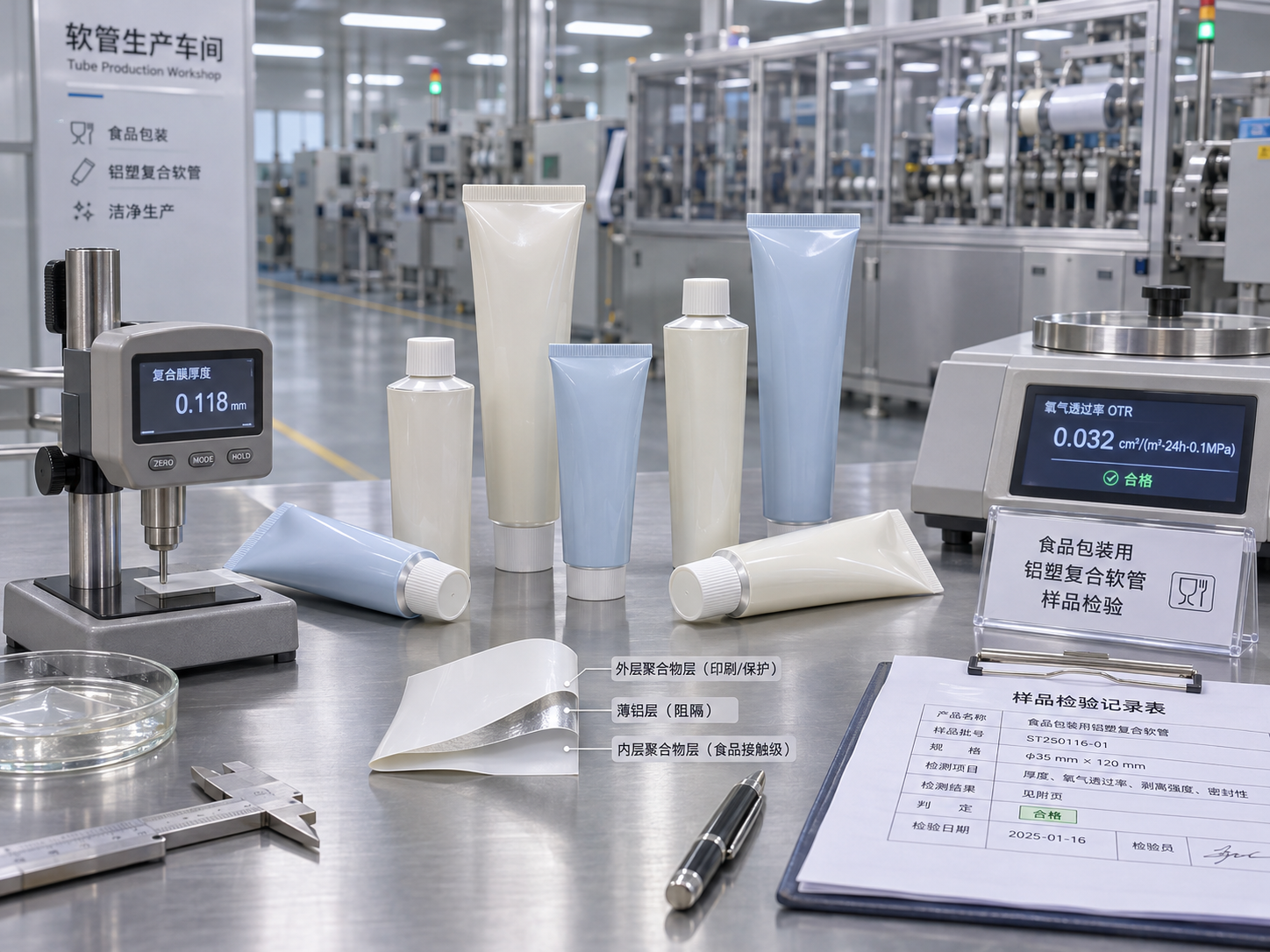
A low quote for a food grade ABL tube manufacturer is useful only when it covers the same laminate structure, food-contact documentation, tube components, testing, and delivery terms as competing offers. Before ordering, establish which production site will make the tubes, what evidence supports the intended food application, and whether the quoted specification has been tested with the actual filling and sealing process. An inexpensive tube that fails a line trial or requires a new compliance assessment can cost more than a higher-priced alternative.
Start with the intended use, then request a binding specification
Aluminum barrier laminate (ABL) tubes combine a foil barrier with polymer layers. The foil helps protect the contents, while the product-contact and sealing layers, shoulder, and closure also affect suitability. An ABL construction alone does not establish that the finished package is appropriate for a particular food.
Send the same application brief to each prospective supplier. State the food type, relevant ingredients, expected contact duration and temperature, filling temperature, storage conditions, target shelf life, and destination markets. Include whether the product will be refrigerated, frozen, heated, or exposed to acidic or oily contents. Describe the filling line, seal configuration, and any requirement for an induction seal or tamper-evident closure.
The resulting specification should identify the laminate construction and nominal thickness, tube diameter and length, shoulder and neck finish, cap type, decoration, and sealing area. It should also define measurable tolerances and agreed test methods. Capacity needs particular care: nominal tube volume does not by itself confirm usable fill volume, headspace, or the length available for a reliable tail seal.
Ask the supplier to identify the actual tube converter and production location. A trading company or sourcing intermediary can coordinate an order, but its quotation should make clear which site manufactures the laminate, forms the tube, and supplies the closure. This matters when production, materials, or subcontractors change after qualification.
Read food-contact evidence against the complete assembly
Request a declaration of compliance or equivalent supporting documentation applicable to the destination market and intended conditions of use. The document should identify the covered material or component, the issuing company, the relevant regulatory framework, and any limitations. A declaration for the laminate film alone does not automatically cover the shoulder, cap, liner, inks, or adhesives used in the assembled tube.
Match the declared contact conditions to the application brief. A document covering dry food at ambient temperature does not establish suitability for an oily paste held for a long shelf life. Likewise, a general statement that raw materials are food grade is weaker evidence than documentation linking the finished construction to its intended use.
Migration testing deserves close attention. Request the test report or an appropriate summary, including the tested article, food simulants, time, temperature, and results against the applicable limits. Where the supplier relies on material-level data or a technical assessment instead of testing the finished tube, ask how that evidence covers the final assembly and processing conditions. Have the regulatory suitability assessed for the specific product and markets; no single certificate establishes compliance everywhere.
Document dates and revision control also matter. Confirm that reports and declarations correspond to the current layer structure, closure materials, and manufacturing site. A change in an adhesive, contact layer, or closure resin can make an earlier assessment insufficient even when the tube looks unchanged. Agree in writing that relevant material and site changes require notification and review before implementation.
Compare laminate constructions without relying on one number
Total laminate thickness is easy to compare but does not describe the whole package. Two structures with the same total thickness can differ in foil gauge, polymer layers, stiffness, seal behavior, and barrier performance. Request the layer sequence and nominal gauges, including the product-contact layer and any protective layers around the aluminum. Where proprietary details cannot be disclosed, obtain enough information to evaluate performance and define a controlled construction.
The intended contents influence the comparison. A strongly flavored food may require particular attention to aroma retention and interaction with the contact layer. A product sensitive to oxygen or moisture needs barrier evidence relevant to the entire package, including the closure. A laminate data sheet alone does not show how well the assembled neck and cap protect the filled product.
Ask how the side seam, shoulder attachment, and tail seal are formed and evaluated. Weak bonding, wrinkles in the sealing zone, or contamination from the filling process can cause leakage even when the foil itself provides an effective barrier. The supplier should state the inspection method and acceptance criteria, not simply promise leakproof tubes.
Appearance also needs limits. Agree on where print registration, color variation, scuffs, and seam appearance are acceptable, using approved artwork and physical references where useful. Keep decoration clear of the tail-seal area unless the construction and sealing process have been qualified for it.
Use samples to separate material issues from line issues
Request production-representative samples rather than relying only on unprinted laboratory tubes. They should match the proposed diameter, length, laminate, shoulder, closure, and print or coating process. Record any differences from the intended production order. A sample made on a different line or with substitute material is useful for preliminary assessment, but it does not fully qualify the quoted configuration.
Run samples through filling, sealing, handling, and storage trials using the intended product where feasible. Include the normal operating range of filling and sealing conditions, as well as expected transport stresses. Examine seal integrity, cap fit, dispensing behavior, tube recovery, laminate separation, and changes in appearance. Assess product compatibility and shelf-life performance under a suitable test plan; a short line trial cannot establish long-term stability.
Investigate a failed seal before assigning the cause. Product contamination at the tail, incorrect seal settings, insufficient seal area, and variations in laminate construction can produce similar leakage. Record the machine settings and failure location, then repeat the trial after the relevant variable is corrected. This avoids rejecting a suitable material or accepting a tube that works only under unusually narrow settings.
Retain approved samples and link them to a written specification and artwork revision. Define whether the approved reference governs color, dimensions, functional performance, or all three. If a feature cannot be judged reliably by visual comparison, specify a measurement method and acceptance limit instead.
Examine production controls and traceability
A site assessment, whether conducted directly or through an independent audit, should follow the tube from incoming laminate and components through forming, printing, packing, and dispatch. Look for documented controls over material identification, line clearance, cleaning, foreign-matter prevention, and segregation of rejected product. The relevance of each control depends on where exposed food-contact surfaces are handled and how the tubes are packed.
Ask for examples of routine inspection records for dimensions, seal or bond integrity, print quality, and closure fit. The useful detail is the connection between a result, its sampling frequency, the acceptance limit, and the action taken when a result falls outside that limit. A quality certificate or audit summary can support the assessment, but it does not replace evidence that the agreed tube specification is controlled during production.
Traceability should run in both directions. A finished-goods lot should link to the relevant laminate and component lots, production date or shift, inspection records, and shipment. Conversely, a material lot should be traceable to affected finished tubes. Ask how quickly records can be retrieved and how mixed lots are identified on cartons and pallets.
Clarify the process for nonconforming goods before placing an order. The agreement should address notification, evidence required for a claim, containment of affected stock, investigation, and disposition. For a defect found after filling, establish how samples and production records will be preserved so the tube, filling process, and handling conditions can be assessed together.
Put competing quotations on the same cost basis
Request a written price breakdown tied to the approved specification and quantity. The lowest unit price may exclude tooling, artwork preparation, printing plates, testing, special packing, freight, duties, or losses associated with minimum order quantities. Separate one-time charges from recurring charges and identify which party owns or controls any dedicated tooling and artwork files.
Compare lead times from the same starting point. One quotation may count from purchase order acceptance; another may start only after artwork approval, deposit receipt, and material availability. Ask for the timing of preproduction samples, production, inspection, and dispatch, along with the consequences of a missed approval deadline.
Minimum order quantity should be evaluated against consumption and shelf-life requirements. A larger run can lower the quoted unit price while increasing inventory exposure, especially when artwork, ingredients, or market labeling are likely to change. Ask whether quantities can be split across deliveries and whether such an arrangement changes pricing, storage charges, or the production lot.
Freight terms need the named delivery point and a clear allocation of loading, transport, insurance, customs, and unloading responsibilities. Also specify carton configuration, palletization, protection from crushing and contamination, and storage conditions. Damage or deformation in transit can affect filling performance even when the tubes passed inspection at the factory.
Before releasing the order
Make the purchase order refer to the final specification, approved artwork, sample reference, compliance documents, agreed test methods, and delivery terms. Resolve any conflict between these documents before production begins. A vague description such as “food-grade printed tube” leaves too much room for differences in construction and acceptance.
For a first order, agree on the release point for production and the records that will accompany the shipment. A staged qualification, beginning with representative samples and a controlled initial run, makes it easier to resolve filling or packaging issues before a larger commitment. Any later change to the laminate, components, production site, or critical process should trigger a documented assessment against the original approval.
Can't find what you're looking for ?
Leave a Message we will call you back quickly!
Product Classification
Professional Service
Interested? Leave your contact details.
Search Starts Here