
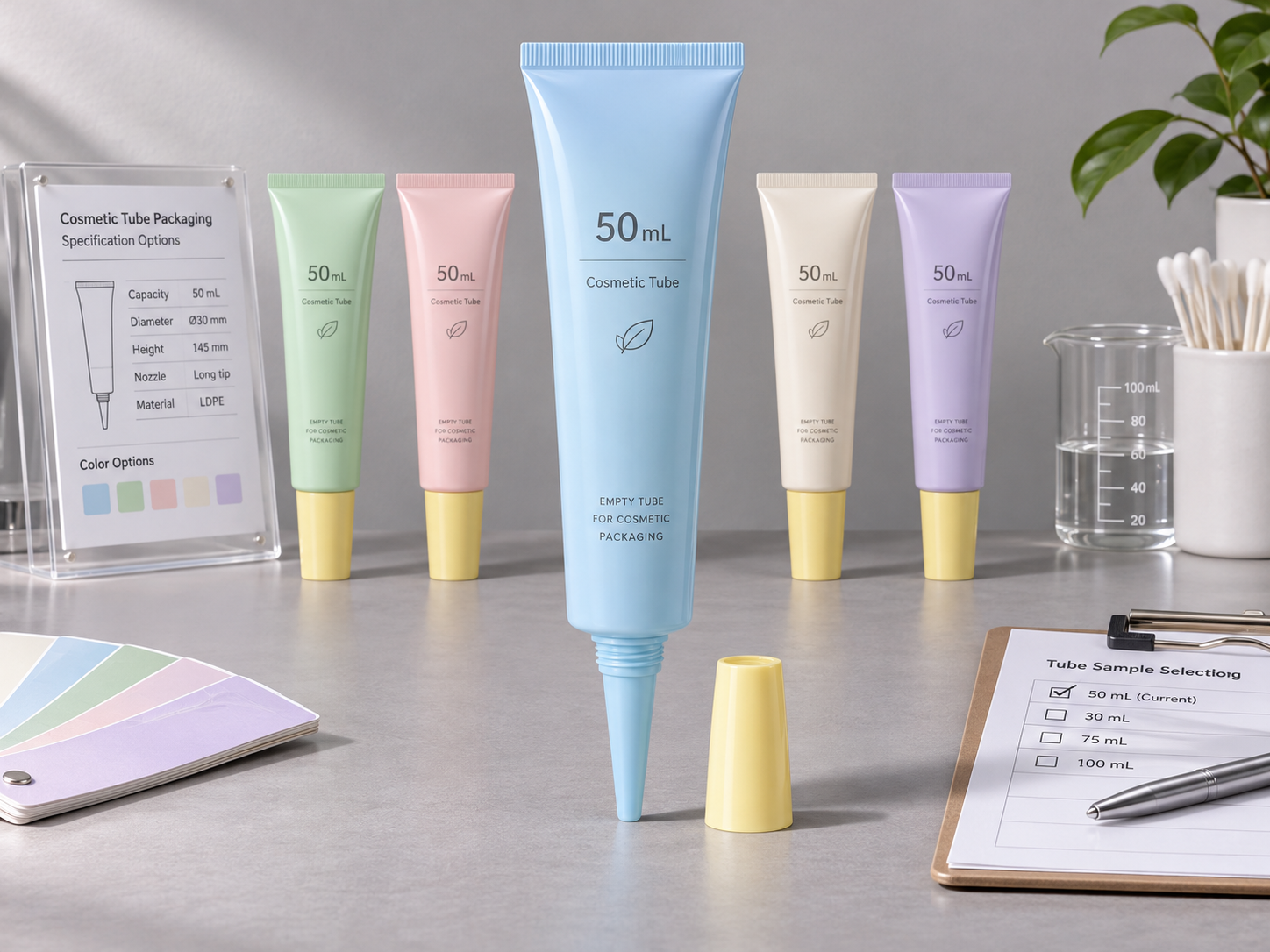
How much does a 50ml long nozzle cosmetic tube cost, and what minimum order quantity should you expect? The answer depends on the specification and order volume.
For early budgeting, an illustrative factory-price allowance of US$0.15–$0.60 per empty tube can help you model a standard plastic tube with a nozzle and basic decoration.
This is a planning assumption, not a verified market quotation. Actual prices can fall outside that range, especially for small runs, complex components, or demanding specifications.
MOQs also vary: a standard configuration may be available in the low thousands, while custom printing or components can require tens of thousands of units.
Whether you package skincare, hair color, or another cosmetic product, the following guide will help you compare quotations, understand trade-offs, and prepare a useful supplier inquiry.
What Should You Budget for a 50ml Long-Nozzle Tube?
A useful starting point is to separate the price of the physical tube from artwork charges, tooling, freight, taxes, and other costs associated with the order.
The table below presents hypothetical budgeting scenarios for an empty, assembled tube. They illustrate how specifications and volume can affect costs; they are not supplier offers.
These examples are deliberately broad. A larger order does not automatically make a premium configuration cheaper than a simpler tube purchased in a smaller quantity.
To build a realistic budget, ask suppliers to quote the same specifications and quantities, then add any separately charged setup, transport, and import costs.
Also confirm whether the price covers the nozzle, cap, assembly, and packing. An inexpensive tube body alone is not comparable with a ready-to-fill assembly.
What Is the Typical MOQ for a Custom Cosmetic Tube?
There is no universal MOQ for a 50ml long-nozzle tube. The minimum depends on available stock, production equipment, printing method, and component sourcing arrangements.
As a starting assumption, ask about quantities from a few thousand units for stock configurations and from 10,000 units upward for custom production or printing.
More specialized designs may require substantially larger orders. These figures are inquiry starting points, not guaranteed supplier minimums, and availability differs by manufacturer and specification.
MOQ can apply separately to the tube body, nozzle, cap, decoration, or material color. The highest component minimum may determine the minimum for the finished assembly.
For example, a supplier may offer a standard nozzle at a low minimum but require a larger run for a custom-colored tube or printed artwork.
Ask whether the quoted minimum is per design, color, SKU, or purchase order. This distinction matters when one product line contains several shades or formulas.
If you plan three designs at 5,000 units each, a supplier requiring 10,000 units per design may treat the order differently from one accepting combined quantities.
Which Specifications Have the Biggest Effect on Price?
The largest price differences usually come from the tube construction, nozzle assembly, decoration, and production volume. Each decision should support the product and dispensing experience.
Tube material and barrier requirements
Extruded plastic tubes and laminate tubes can both serve cosmetic applications, but their construction, appearance, barrier properties, and manufacturing requirements differ by specification.
Some formulas need stronger protection against oxygen, moisture, or light. A suitable barrier can add cost, but insufficient protection may create much greater product losses.
Do not choose a material from price alone. Share the formula’s relevant characteristics and intended shelf life so the supplier can suggest structures for testing.
Nozzle design and closure
A long nozzle directs product into a narrower area, which can be useful for targeted skincare or hair color application. Length alone does not determine performance.
Orifice diameter, nozzle shape, cap fit, and the way the nozzle joins the tube all influence flow, cleanliness, and the user’s ability to control dispensing.
A standard nozzle and cap can reduce development expense and simplify replenishment. A unique shape may involve tooling, longer lead times, and higher minimum quantities.
Printing and finish
Decoration affects both shelf appeal and setup cost. Print coverage, color count, artwork complexity, and finishing processes can all influence a supplier’s quotation.
A simple design using an available tube color may cost less to launch than a heavily decorated tube with special finishes and multiple production steps.
Ask for the print method, color tolerances, and artwork requirements before approving the quotation. Request a production sample when appearance is critical to brand presentation.
Order volume and repeat orders
Higher volume can spread setup and production costs across more units. However, ordering beyond realistic demand ties up cash and increases storage and obsolescence risk.
Compare the total cost of quantities you can reasonably use, not just the lowest unit price. Confirm whether a repeat order will incur setup charges again.
How Do You Compare Quotes Without Missing Hidden Costs?
Request an itemized quotation and specify whether you need a tube body, nozzle, cap, assembled package, or another configuration. Ambiguity makes price comparisons unreliable.
Ask each supplier to identify the currency, quantity, validity period, payment terms, production lead time, and any charges excluded from the quoted unit price.
Shipping terms matter because they determine which transport responsibilities and costs are included. Name the applicable Incoterms rule and location when requesting an international quotation.
For a landed-cost estimate, add the applicable freight, insurance, import duties, taxes, and local handling costs to the product and setup charges you expect to pay.
For example, 10,000 tubes at an assumed US$0.25 each cost US$2,500 before additional charges. A US$300 setup fee raises the pre-shipping total to US$2,800.
That example equals US$0.28 per tube before freight and import costs. It shows why a low quoted unit price may not be the lowest overall option.
Also compare tolerances, defect handling, sample fees, and replacement terms. A slightly higher quote may be better value if it reduces filling or leakage problems.
How Can a Smaller Brand Manage a High MOQ?
Start by asking which existing tube bodies, nozzles, caps, and colors are already available. Standard components may avoid custom tooling and reduce minimum-order constraints.
Consider a simpler decoration or an available stock color if it supports your brand. Confirm that any alternative remains compatible with the formula and filling process.
Ask whether the supplier offers smaller trial quantities, stocked inventory, or a staged delivery arrangement. Availability and payment obligations should be confirmed in writing.
If you have multiple product variants, explore whether they can share the same tube and closure. Check whether printing or labeling still creates separate minimums.
A larger order may look attractive on price, but calculate storage costs and expected sales first. Packaging changes can leave unused stock with little resale value.
For a first launch, a manageable quantity and reliable delivery can be more valuable than securing the lowest theoretical price at an impractical production volume.
How Do You Check That the Tube Works With Your Product?
A long nozzle should dispense the intended formula consistently without excessive force, unwanted dripping, or blockage. Performance depends on the complete package and product combination.
Share the product type, approximate viscosity, filling method, and expected conditions of use. A nozzle suitable for a thin serum may frustrate users with thicker cream.
Test representative filled samples for dispensing, cap fit, leakage, and appearance. Include the actual filling and sealing process whenever possible, rather than testing empty tubes alone.
Run compatibility and stability evaluations appropriate to the formula, packaging, storage conditions, and intended shelf life. Your product and quality teams should define acceptance criteria.
For hair color or other reactive formulations, discuss component resistance and any relevant chemical requirements with the supplier. Do not assume that cosmetic use guarantees compatibility.
Confirm which documents are available for the chosen materials and destination market. Any regulatory assessment should reflect the finished product, its claims, and applicable local rules.
If environmental performance is a priority, request the exact material composition and supporting information. Recyclability depends on the complete package and local collection and processing systems.
What Should You Include in a Request for Quotation?
A detailed inquiry helps suppliers identify workable components and produce comparable prices. Include enough information to describe both your packaging needs and your purchasing constraints.
- Product type, target fill volume, formula characteristics, and relevant compatibility requirements.
- Tube construction or desired barrier properties, if known, plus preferred dimensions and color.
- Nozzle length, desired orifice size, cap style, and any dispensing requirements.
- Artwork, print coverage, number of designs, and desired finish.
- Quantities per design, expected reorder volume, and requested price breaks.
- Delivery destination, requested shipping terms, target delivery date, and required documents.
If dimensions or materials are undecided, provide a reference sample or describe the dispensing experience you want. Ask suppliers to recommend options with clear trade-offs.
Request prices at several realistic quantities, such as 5,000, 10,000, and 20,000 units, while asking suppliers to identify which quantities meet their actual minimums.
Finally, ask for sample timing, production timing after artwork approval, and the process for resolving quality issues. These details help turn a quotation into a workable plan.
Choosing the Right Supplier and Next Steps
When assessing suppliers, look beyond the initial quote. Compare their ability to source consistent components, explain material options, support sampling, and communicate production requirements clearly.
Shanghai Pactek Industries Co., Ltd. provides customized packaging procurement services and works with manufacturing partners in China. Its portfolio includes laminate and extrusion tubes.
For a project inquiry, provide your product requirements and expected quantities so the team can discuss suitable configurations, applicable MOQs, and a project-specific quotation.
The right purchase balances unit cost with compatibility, order size, and supply reliability. Use indicative figures for planning, then make your decision using comparable written quotes.
Can't find what you're looking for ?
Leave a Message we will call you back quickly!
Product Classification
Professional Service
Interested? Leave your contact details.
Search Starts Here