
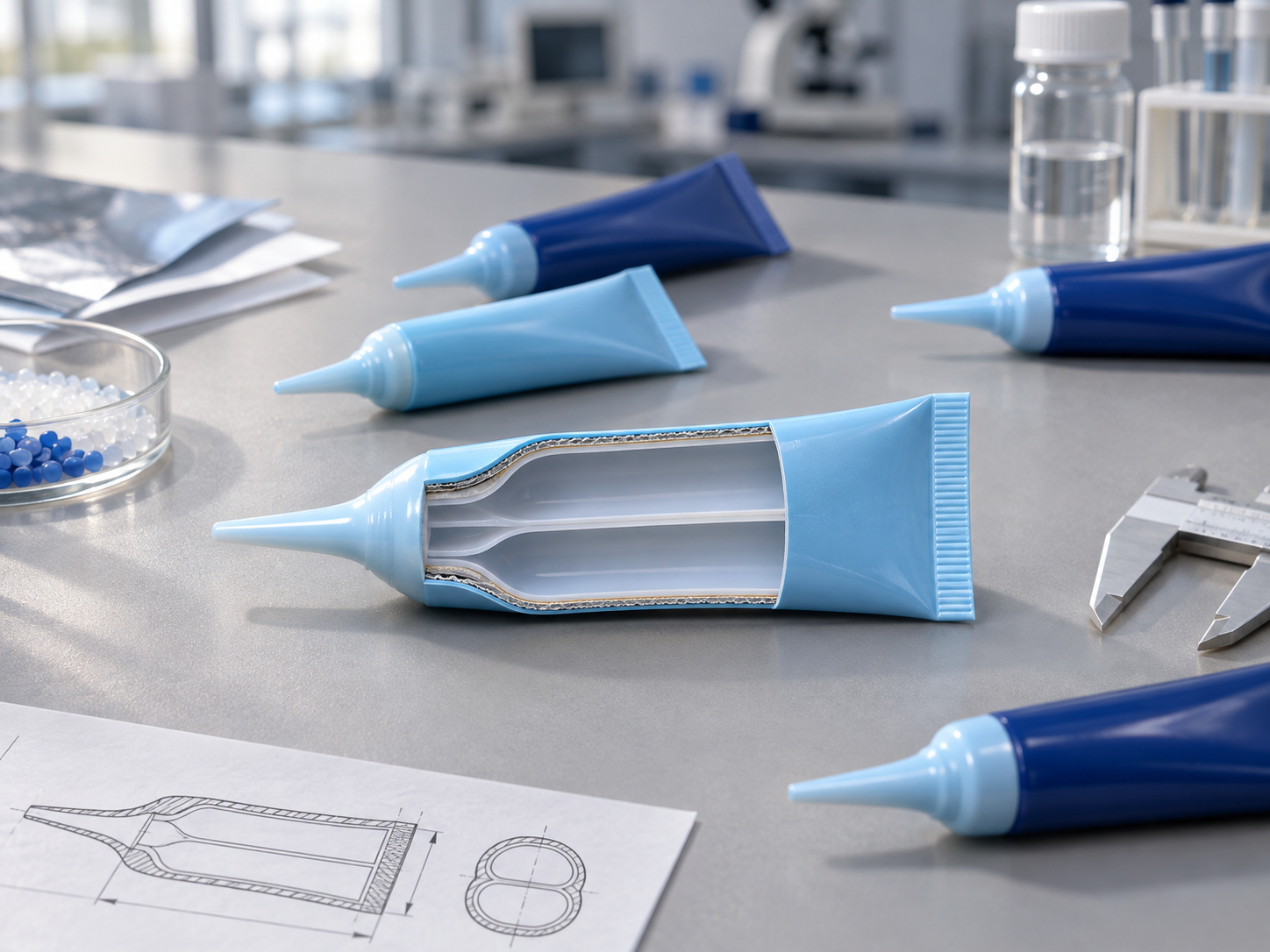
Will a 4ml laminate tube keep two-part adhesive components separate? It can, but only if the complete package is designed to isolate the resin and hardener until they are dispensed. A conventional single-chamber laminate tube does not provide that separation. A dual-chamber design, a sealed internal division, or another engineered arrangement may do so, provided the materials, seals, and dispensing system are compatible with the adhesive.
For packaging buyers, the question is not simply whether a tube holds 4ml. It is whether a compact package can maintain separation during filling, storage, transport, and use—and deliver the components in the proportions the adhesive requires.
Why can’t a standard laminate tube hold both components separately?
Most standard laminate tubes have one internal cavity. If resin and hardener are filled into that shared space, they can contact each other and begin reacting. A cap prevents product from escaping, but it does not create a barrier between ingredients already inside the tube.
Keeping the two components apart requires a physical separation that extends through the entire filled area and remains intact at the shoulder, seal, and dispensing end. Depending on the design, that might involve two distinct compartments, an internal barrier, or separate containers combined in an assembly.
Laminate describes the layered material used to make the tube; it does not, by itself, tell you how many chambers the package has. When requesting a quotation, specify the separation requirement rather than assuming that a laminate tube will have it.
What does “4ml” mean for a two-part adhesive package?
Before comparing designs, establish whether 4ml refers to the combined fill volume or to the capacity of each component. A package containing 4ml in total may have very little space available for each material, depending on the required mixing ratio.
For example, a 1:1 ratio by volume would call for equal quantities of resin and hardener. A different ratio requires differently sized fills or a dispensing mechanism designed to deliver the correct proportions. The ratio must be taken from the adhesive formulation’s instructions; a ratio by weight is not automatically the same as a ratio by volume because the components may have different densities.
Also distinguish nominal package capacity from practical fill volume. Headspace, seals, chamber geometry, and dispensing features can all affect how much product the finished pack can accommodate. Confirming these details early helps avoid a compact design that looks suitable on paper but cannot be filled and used reliably.
How can two components be separated in a small package?
There is more than one possible arrangement, and a laminate tube is not necessarily the best fit for every formulation. The right choice depends on the adhesive, the required dose, and whether the components need to mix during dispensing.
A dual-chamber concept may be attractive because it brings both components into one unit. At 4ml, however, the divider, seals, and outlet take up a proportionally important amount of space. The feasibility of a particular design should be confirmed with the packaging supplier rather than assumed from the concept alone.
Does separation continue all the way to the nozzle?
This is an easy detail to overlook. Two isolated chambers are not enough if their contents can meet inside a shared outlet during storage or after the cap is replaced. Depending on the adhesive, residual material at the opening may react, obstruct the outlet, or contaminate a component.
Ask how the proposed dispensing head prevents contact before use. If the pack is intended for repeated applications, discuss what happens after the first dose: whether material remains in the outlet, whether the opening can be closed without cross-contamination, and whether the dispensing system is intended for single or multiple uses.
Some systems bring the components together only as they leave the pack, while others rely on the user to dispense and mix them separately. A mixing nozzle may be useful for certain products, but it also adds volume and can retain adhesive after use. For a small fill, that retained amount deserves attention because it may affect the quantity available for the application.
Will a dual-chamber pack dispense the correct mixing ratio?
Not necessarily. Physical separation protects the components before use; accurate delivery is a separate requirement. Chamber dimensions, outlet resistance, component viscosity, and the way the user applies pressure can all influence dispensing.
Two materials may flow differently even when their chambers appear symmetrical. A thick resin and a thinner hardener, for example, may not leave the package at the same rate when squeezed. Uneven delivery can produce a mixture that does not perform as intended.
Before selecting a package, share the required mixing ratio and the viscosity characteristics of both components with the supplier. The finished design should then be evaluated with the actual formulation. Consider testing doses at the beginning, middle, and end of use, including the effect of ordinary variation in how different people squeeze or operate the pack.
If users must measure the components themselves, instructions should make the required proportions and mixing process clear. A convenient-looking pack is of limited value if the user cannot prepare the adhesive consistently.
Which laminate and sealing properties matter most?
The laminate structure must be assessed against each component separately. Resin and hardener can present different packaging challenges, so a material that works for one side should not automatically be approved for the other.
Contact-layer compatibility
The inner layer is in direct contact with the adhesive. Depending on the formulation, it may be affected by solvents, reactive ingredients, or other chemicals. Check for changes such as swelling, softening, cracking, leakage, or visible changes in the stored component. Equally important, examine whether the packaging affects the adhesive’s intended properties.
Barrier performance
Some components are sensitive to moisture, oxygen, or loss of volatile ingredients. A laminate can incorporate barrier layers, but the necessary level of protection depends on the formulation and the intended storage conditions. The barrier must be considered across the whole package, including the shoulder, closure, seals, and any interface between chambers—not just the tube wall.
Seal integrity
A small defect in a chamber divider or seal can undermine the entire separation concept. The package needs suitable seals both where product could escape and where the two components could cross between compartments. Filling conditions matter too: adhesive contamination in a sealing area may interfere with seal formation, so the proposed production process should be assessed alongside the package design.
What should be tested before approving a 4ml pack?
A drawing or an empty sample can help establish dimensions, but neither demonstrates that the filled package will keep a particular adhesive stable. Testing should use representative components and the intended package configuration, including its closure and dispensing features.
- Separation: Check for transfer between compartments throughout filling, storage, handling, and dispensing.
- Compatibility: Evaluate each component in contact with the intended materials and look for changes in the package and product.
- Leak and seal performance: Assess the filled pack under conditions relevant to handling and distribution, including pressure or compression where appropriate.
- Storage stability: Review performance over the intended shelf life and temperature conditions using a test plan suited to the formulation.
- Dispensing and ratio: Measure whether the system delivers usable quantities in the required proportions across the pack’s intended use.
- User handling: Check opening, squeezing, mixing, and any resealing steps with the people expected to use the product.
Acceptance criteria should be agreed before testing. For instance, “no obvious leak” may not be a sufficient definition if the application also requires a controlled mixing ratio or a specific adhesive performance after storage. The adhesive manufacturer and packaging supplier should determine suitable methods and limits for the product.
Is a laminate tube the right choice for every two-part adhesive?
No. A compact laminate format may be worth investigating when a lightweight, portable pack suits the application and an appropriate separation and dispensing design is available. It may be less practical when the formulation needs very precise metering, the components have markedly different flow properties, or the dispensing system would retain too much of a small fill.
Two separate single-chamber tubes can be a simpler way to keep components apart, but the user must then measure and mix them correctly. A dedicated dual-component applicator may offer a different dispensing experience, although its suitability at 4ml still needs to be checked. The choice is a balance between product protection, dosing control, manufacturing feasibility, and ease of use.
What information should buyers give a packaging supplier?
A useful inquiry starts with more than “4ml laminate tube.” Share the total fill volume, the quantity of each component, and whether the mixing ratio is specified by volume or weight. Explain whether the product is single-use or intended to be reopened, how the components should be mixed, and how accurately they need to be dispensed.
Provide available information on viscosity, chemical compatibility, moisture or oxygen sensitivity, storage conditions, and the expected shelf life. If a dispensing nozzle or applicator is required, describe the application and any limits on product left in the device. The supplier can then assess possible formats and identify what requires sampling or further testing.
Shanghai Pactek Industries Co., Ltd. supplies laminate packaging solutions and works with manufacturing partners in China on packaging procurement and customization. For a two-part adhesive inquiry, discussing the formulation requirements and intended dispensing method early can help establish whether a suitable laminate-based configuration is feasible or whether another format should be considered.
Can a 4ml laminate tube keep two-part adhesive components separate in practice?
Yes, a suitably engineered package may do so—but a standard single-chamber tube cannot keep both components apart inside the same cavity. The answer depends on the chamber construction, seals, outlet, material compatibility, and filling and dispensing processes.
For a buyer, the most reliable decision is to treat separation, dosing, and product stability as connected requirements. Confirm the meaning of the 4ml capacity, review the complete package rather than the laminate alone, and validate the proposed design with the actual adhesive before committing to production.
Can't find what you're looking for ?
Leave a Message we will call you back quickly!
Product Classification
Professional Service
Interested? Leave your contact details.
Search Starts Here