
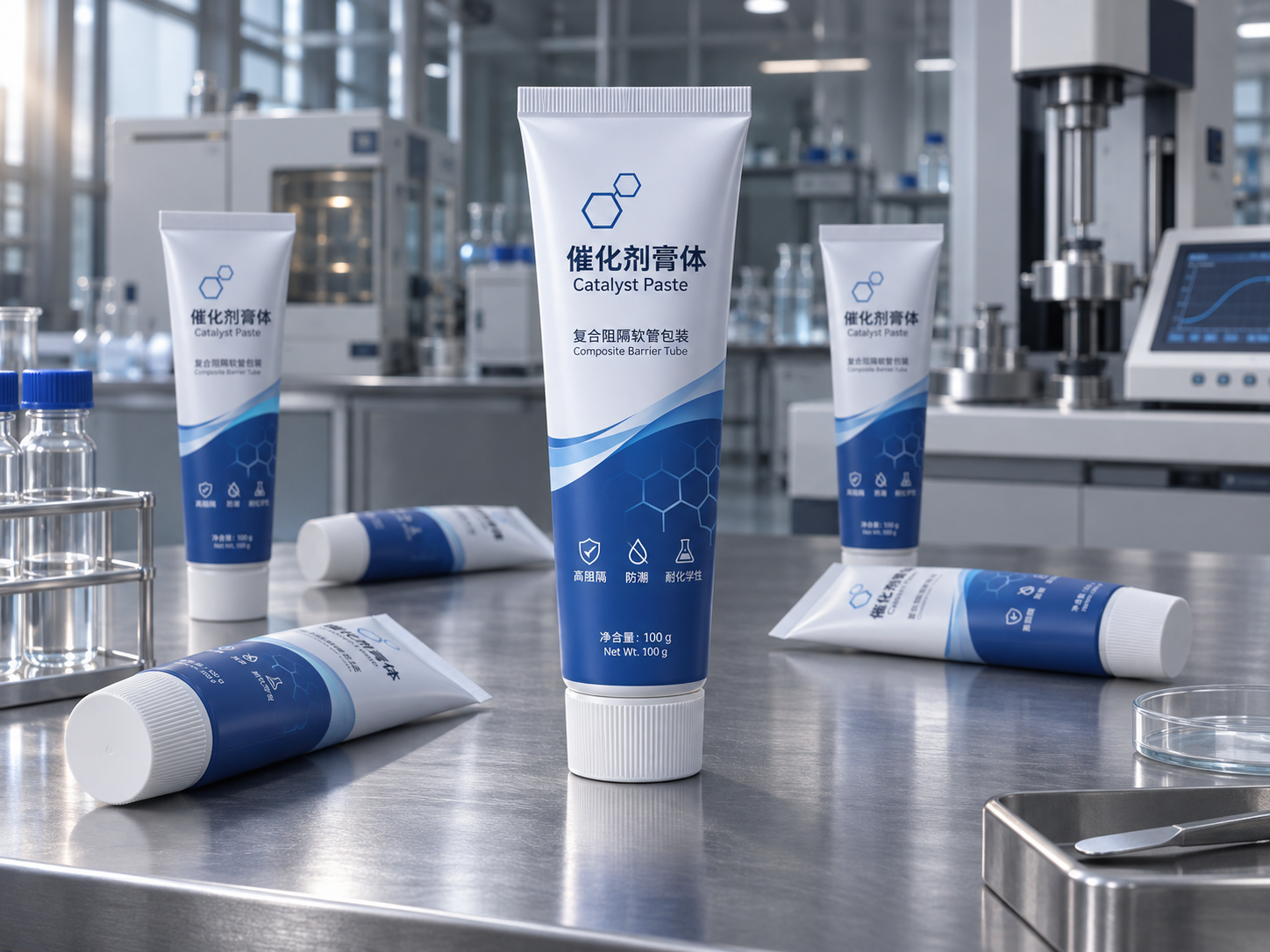
Are barrier tubes suitable for moisture-sensitive catalysts? They can be, if the complete package limits moisture exposure enough to protect the catalyst throughout filling, storage, transport, and use. A tube with a moisture-resistant body is a useful starting point, but its seals, closure, filling conditions, and compatibility with the formulation all affect the result.
The decision depends on the catalyst as well as the package. A formulated catalyst paste dispensed in small amounts may benefit from a squeezable tube. A highly reactive powder that requires controlled-atmosphere handling may need a more protective primary container. The practical question is whether the proposed tube system can maintain the catalyst’s required performance through the entire intended shelf life and use period.
What can moisture do to a catalyst?
Some catalysts react with water or lose activity when their surface is exposed to humidity. Others may absorb moisture, change consistency, form lumps, or become harder to dispense. In certain formulations, moisture can also affect the carrier, stabilizers, or other ingredients, even if the active catalyst itself is relatively stable.
These changes do not always produce an obvious visual warning. A paste can look normal yet behave differently during curing or processing. For that reason, packaging decisions should be tied to the property that matters in use: activity, reaction time, consistency, dispensing behavior, or another relevant measure.
Moisture sensitivity also varies with exposure. A material that tolerates brief contact with ambient air during dispensing may still deteriorate after months in a package that allows slow moisture ingress. Conversely, a product stable in a sealed tube may be unsuitable for repeated opening in a humid workplace.
How does a barrier tube limit moisture ingress?
A barrier tube reduces the rate at which water vapor moves from the surrounding air toward the product. Laminate tubes achieve this through layers with different functions: some provide structure and sealability, while a barrier layer limits permeation. Depending on the construction, that barrier may include aluminum foil or another barrier material.
Aluminum foil can provide a strong barrier when it forms a continuous, intact layer. Its presence alone does not establish the performance of the finished tube, however. The barrier also depends on the condition of the laminate, the tube’s construction, and the integrity of the finished package.
Plastic-based barrier structures can be useful where flexibility, appearance, or processing requirements favor them. Their moisture protection depends on the materials and construction used, as well as the storage environment. A tube described simply as “plastic barrier” does not tell a buyer enough to assess its suitability for a particular catalyst.
Standard extrusion tubes may offer a different balance of flexibility and protection. Some multilayer constructions include barrier materials, but an extrusion tube should not be assumed to provide the same protection as a particular laminate. Ask for information on the proposed structure and evaluate the finished package against the product’s requirements.
Which parts of the tube need attention?
Water vapor can enter through the body over time, but the body is only one part of the package. A useful assessment follows the entire path from the filled product to the outside environment.
The tube body and its formed seams
Request the proposed layer structure and relevant moisture barrier data for the material. Then establish how the tube is made and whether forming, handling, squeezing, or transport could damage the barrier. Creases, abrasion, or localized defects may matter more for a highly sensitive product than for a formulation with a greater moisture tolerance.
Material data is helpful for comparing candidates, but it may describe a flat sample under specified conditions. It does not automatically predict the moisture ingress of a finished tube with a shoulder, closure, and sealed end.
The tail seal
The filled end of a tube must be sealed consistently. Product trapped in the seal area, an unsuitable sealing surface, or poorly controlled sealing conditions can create a path for leakage. Powders and sticky pastes deserve particular attention because they can contaminate the area that must bond.
The seal should be evaluated using the actual formulation and filling process. A clean seal made on an empty sample does not necessarily represent the seal produced during normal filling.
The nozzle, closure, and opening
The shoulder, nozzle, cap, and any additional seal form another part of the barrier system. Thread fit, closure design, and how reliably the cap is applied all influence protection. A sealed membrane or other initial closure may improve protection before first use, provided it is compatible with the contents and the way the product will be opened.
After that seal is removed, performance depends on how well the tube is reclosed and how long it stays open. A cap that works well on a clean nozzle may be less effective if catalyst residue prevents it from seating properly.
Does a good moisture barrier guarantee catalyst stability?
No. A package can restrict moisture ingress and still be unsuitable because of chemical incompatibility. The catalyst or its carrier may react with, soften, swell, or permeate a contact layer. Ingredients may also migrate from the packaging into the formulation and affect product performance.
This is especially relevant when a formulation contains solvents, reactive components, or additives that interact with polymers. The innermost layer is in direct contact with the product, but the entire structure matters if ingredients can move through that layer.
Compatibility should be assessed with the complete formulation, not just the catalyst’s chemical name. Storage tests can look for changes in catalyst performance, viscosity, color, odor, tube integrity, and dispensing behavior, as appropriate to the product. The closure and any liner or seal should be included in that assessment.
When is a tube a practical choice?
A barrier tube is often worth considering for a catalyst supplied as a paste or gel, especially when users need controlled dispensing from a relatively small pack. Squeezing can help move product toward the nozzle, and a suitable closure can make the format convenient for applications that require more than one use.
The format can also work for a single-use portion. In that case, the package only needs to protect the product until opening, and the user does not need to rely on a cap to preserve the remainder. Portion size should match the amount normally consumed in one operation; excess product left in an opened tube may receive a different level of protection from an unopened pack.
For a dry catalyst, the decision is less straightforward. Flowing powder may be difficult to fill or dispense cleanly from some tube designs, and dust in the sealing area can interfere with closure integrity. A tube may still be possible, but the filling method, nozzle design, and seal quality need careful assessment.
When should you consider another package?
A tube may be a poor fit when the catalyst reacts rapidly with traces of moisture or requires stringent control of oxygen as well as water vapor. A container that can be filled and closed under controlled conditions, with a closure designed for that requirement, may be more appropriate. For some products, a sealed inner container or an additional protective package may be necessary.
Rigid containers can also be easier to handle when the product is abrasive, difficult to squeeze, or supplied in larger quantities. A foil pouch may suit a measured single-use charge, while a rigid sealed container may better support repeated withdrawal using a controlled procedure. Each format still requires compatibility and closure assessment; changing the shape alone does not solve the moisture problem.
Where a catalyst can react dangerously with water or generate pressure, packaging selection must also account for safe filling, storage, handling, and transport. The tube’s convenience should not determine the choice before those product-specific hazards have been addressed.
How should a proposed tube be evaluated?
Start with the product’s allowable exposure and required shelf life, then work outward to the package and process. A useful evaluation covers these questions:
- What must remain within specification? Define the relevant measure of catalyst performance and any acceptable changes in consistency or dispensing.
- What conditions will the pack encounter? Include expected temperature and humidity during storage, shipping, and use. Consider whether condensation could occur when a cold package is moved into a warmer environment.
- How will the tube be filled and sealed? Specify the filling environment, product temperature where relevant, seal cleanliness, and closure application method.
- How will the user dispense the product? Decide whether the pack is single-use or resealable, how often it may be opened, and how long the remaining contents must stay usable.
- How will the complete pack be tested? Assess filled, sealed tubes through storage and representative handling, then measure both package condition and catalyst performance.
Include the intended outer packaging when evaluating transport and storage. A protective pouch or secondary container may reduce exposure, but it should be treated as part of the defined package system, with its own seals and opening procedure. Once that outer protection is removed, the tube must provide whatever protection the remaining use period requires.
Comparison tests are most useful when candidate packs contain the same formulation and are exposed to the same representative conditions. Checking the product at intervals can reveal whether changes develop gradually or appear after opening or handling. Results should support the proposed shelf life and use instructions rather than rely on an attractive material specification alone.
Can the tube be filled in normal room air?
That depends on how quickly the product takes up moisture and how much exposure it can tolerate. A strong barrier cannot remove water introduced before sealing. If the catalyst is exposed to humid air during mixing, filling, or a pause on the line, the filled tube may begin its shelf life with more moisture than intended.
For sensitive formulations, controlled humidity or another controlled filling atmosphere may be needed. The filling equipment, product feed, and empty tubes should all fit the chosen process. It is also useful to define how long filled tubes can remain open before sealing and how the seal area will be kept clean.
What should you discuss with a packaging supplier?
Share the formulation’s packaging requirements early enough for the supplier to suggest a suitable structure and closure. Useful information includes the product form, known compatibility concerns, desired pack size, filling method, storage conditions, shelf-life target, and whether the tube will be opened once or repeatedly.
Ask for the proposed material structure, contact layer, closure options, and available barrier information, along with samples suitable for filling and evaluation. Discuss which features can be adjusted if the first construction does not meet the product’s needs. Shanghai Pactek Industries Co., Ltd. supplies laminate and extrusion tubes among its packaging products; a proposed construction for a catalyst would still need to be assessed with the actual formulation and process.
The most useful outcome is a package specification linked to the product’s acceptance criteria: a defined tube and closure, a workable filling and sealing method, and evidence that the catalyst remains fit for use under the intended conditions.
Can't find what you're looking for ?
Leave a Message we will call you back quickly!
Product Classification
Professional Service
Interested? Leave your contact details.
Search Starts Here