
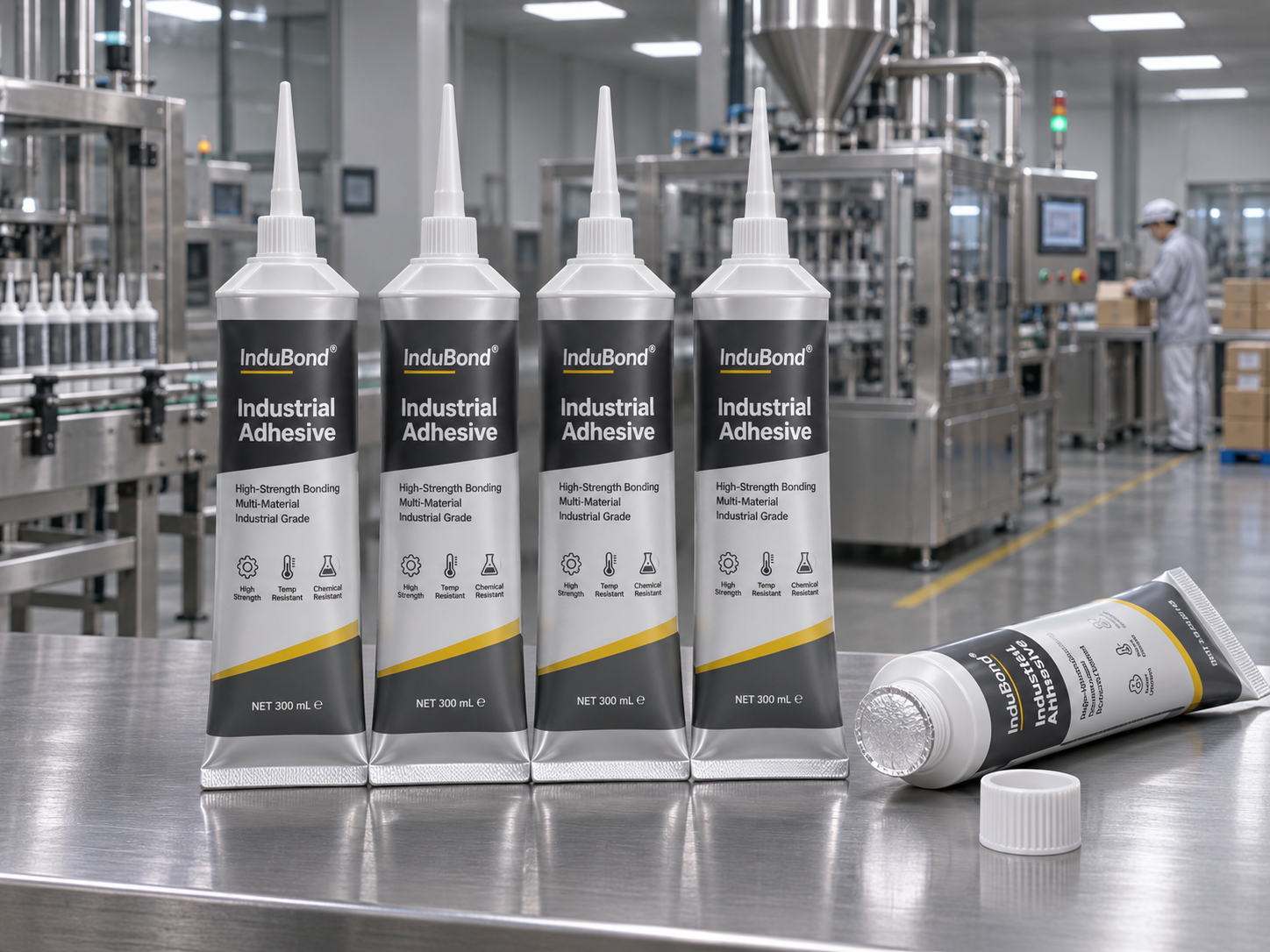
From Our Factory Floor: A Guide for Chemical Procurement Managers
Packing toothpaste is easy. Packing industrial adhesives, silicone sealants, or highly reactive chemical catalysts? That’s a different beast entirely.
In our decades of manufacturing tubes, we’ve seen brands try to use standard cosmetic tubes for industrial chemicals, only to end up with a warehouse full of leaking, swollen, or shattered tubes. If you are sourcing packaging for industrial adhesives, here is the harsh reality of what you need to consider.
1. The "ESCR" Nightmare (Environmental Stress Cracking)
Industrial chemicals often contain aggressive solvents (like acetone, xylene, or toluene). When these solvents come into contact with standard low-density polyethylene (LDPE), they penetrate the polymer matrix, causing the tube to swell and eventually crack under slight pressure. We call this ESCR (Environmental Stress Cracking).
The Fix: You cannot use standard cosmetic-grade PE. You need a tube engineered with specialty high-density resins (HDPE) or specific co-polymers. For highly aggressive solvents, we often recommend a thick-walled Extruded Tube with a customized inner barrier layer to resist chemical penetration.
2. ABL, PBL, or Extruded?
ABL (Aluminum Barrier Laminate): Highly resistant to UV and oxygen, but the aluminum layer can react with highly acidic or alkaline catalysts. If your adhesive is neutral, ABL is great for preventing moisture curing.
Extruded Tubes: Because they are mono-layer and seamless, they are often the most cost-effective choice for industrial sealants (like silicone). However, their barrier properties are lower.
PBL (Plastic Barrier Laminate): The best of both worlds. Using an EVOH barrier layer, it offers chemical resistance and excellent barrier properties without the aluminum corrosion risk.
3. The Dispensing Nightmare (Nozzles and Orifices)
Industrial users (like construction workers or mechanics) don't care about "pretty packaging." They care about precision and speed.
If the adhesive is too thick, a standard nozzle will burst off the tube.
The Factory Solution: We manufacture custom nozzle orifices designed for high-viscosity dispensing. We also use reinforced high-impact HDPE shoulders that can withstand the high pressure applied by a heavy-handed user without cracking at the weld line.
4. Safety and Tamper-Evidence
Industrial chemicals can be dangerous. The packaging must protect the user.
Ensure your tubes have a secure, tamper-evident seal (like an induction foil seal under the cap) to prevent accidental leakage during transport.
Make sure the tube surface supports high-contrast printing for crucial safety warnings (e.g., GHS hazard symbols) and batch codes.
Our Factory Bottom Line:
Industrial packaging is where cheap materials go to die. Before you place a mass order, send us your chemical formulation (SDS sheet) and let our lab run a compatibility swell test. We'll tell you exactly which resin and tube structure will prevent your product from turning into a leaky mess on the pallet.
Can't find what you're looking for ?
Leave a Message we will call you back quickly!
Product Classification
Professional Service
Interested? Leave your contact details.
Search Starts Here