
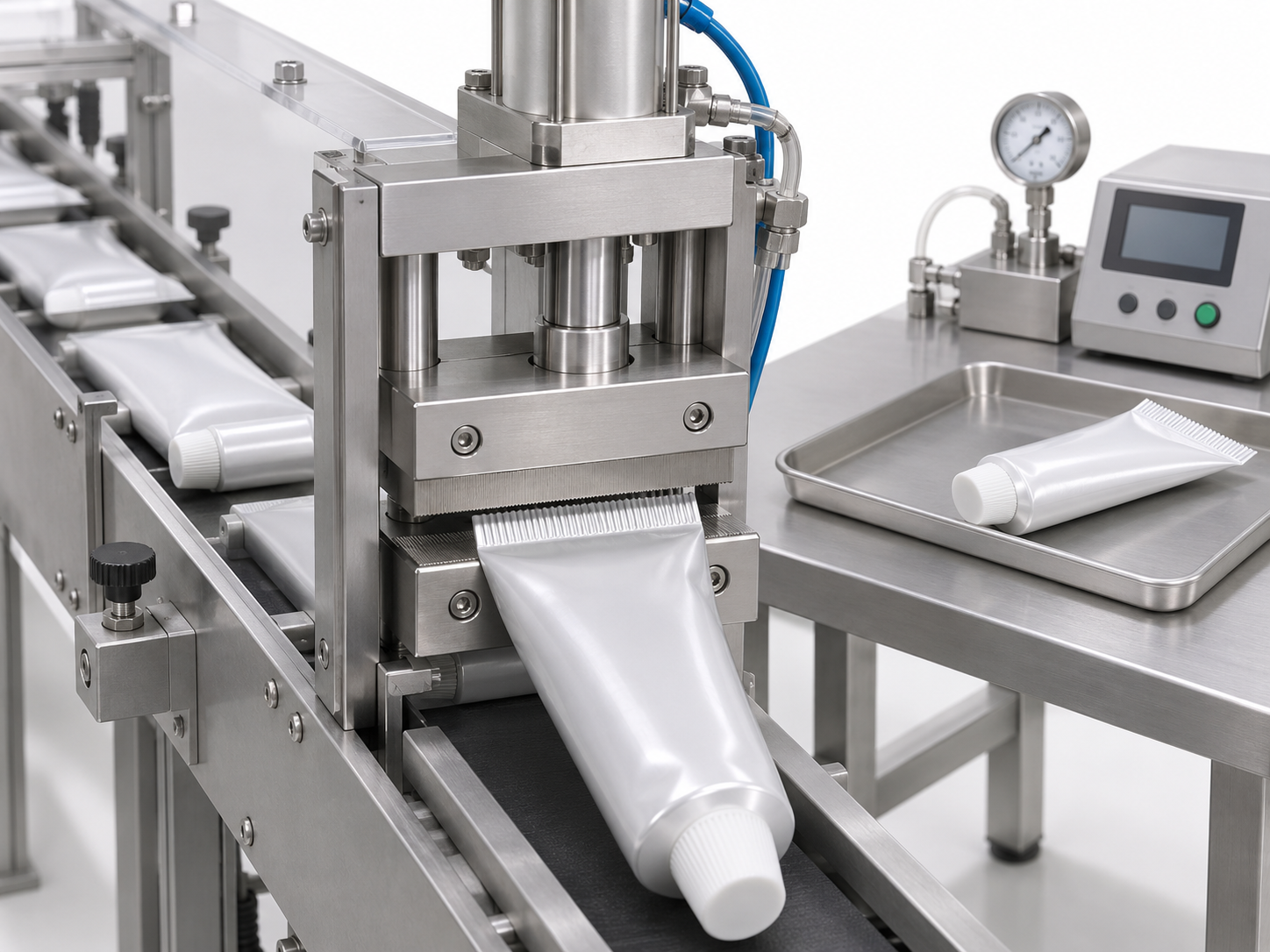
From Our Factory Floor: The Operator’s Guide to the Perfect Seal
In our last guide, we talked about how microscopic contamination causes the dreaded "False Seal." But let’s say you have a perfectly clean tube, a perfectly matched formula, and zero splashes. Yet, the tube still leaks.
Why? Because the sealing machine parameters are fighting against the physical limits of the material.
Walk onto any factory floor and you’ll see operators constantly tweaking three dials: Temperature, Pressure, and Dwell Time. We call this the "Golden Triangle." If you get the settings wrong, you are either creating a seal that will peel apart in the warehouse, or you are literally cutting the tube from the inside.
Here is what actually happens when the settings are off, and what we do about it in our production lines.
1. Temperature: The Danger of "Turning It Up to Eleven"
The most common rookie mistake is thinking hotter means stronger. ABL tubes rely on the inner LDPE (Low-Density Polyethylene) layer melting and fusing.
Too Cold (The "Kissing" Seal): The PE barely softens. The jaws press the layers together, but they don't interlock. It looks sealed, but the moment the tube cools or gets squeezed, it pops open.
Too Hot (The "Brittle" Seal): This is the nightmare. If the jaw is too hot, the PE doesn't just melt—it degrades and oxidizes. It turns brittle and yellowish. The seal might be incredibly strong on day one, but the heat-affected zone right next to the jaw becomes a weak point. Under stress, it cracks right along the edge.
The Factory Fix: We use high-precision digital controllers, not just analog dials. More importantly, our operators don't just stare at the temperature display. They look at the seal serrations. A perfect seal has sharp, well-defined teeth. If the teeth look smeared or flattened, the temperature or pressure is off.
2. Pressure: The Illusion of "Squeezing It Shut"
You might think maximum pressure guarantees a zero-leak seal. It doesn't.
Too Low: The molten PE can't bridge the microscopic gaps between the layers, leaving micro-channels for your liquid to escape.
Too High (The "Pinch-Off" Effect): This is where physics gets tricky. If the jaws crush the tube too hard, all the melted PE gets squeezed out of the seal zone, leaving a paper-thin layer of material with zero structural integrity. We call this "pinch-off." It’s like tying a balloon too tight—the rubber gets so thin it breaks.
The Factory Fix: We adjust the pressure based on the wall thickness of the specific ABL tube and the formula's viscosity. Thick toothpaste and thin pharma gels need different jaw pressures. We also constantly check the jaw parallelism. If the top of the jaw touches but the bottom doesn't, you get a leaky tube every time.
3. Dwell Time: The Speed vs. Quality Battle
Dwell time is how many milliseconds the jaws stay closed.
Too Fast: If your machine is running at 120 tubes per minute, the heat might not have enough time to conduct through the inner PE layer. You get a surface melt, but a cold core.
Too Slow: The PE gets over-cooked, leading to the same brittle failure as high temperature. Plus, it slows down your entire production line.
The Factory Fix: This is where machine synchronization matters. You must match your dwell time with your line speed and the specific resin formulation of the tube. When we supply ABL tubes, we provide the exact recommended sealing window (e.g., 180°C ± 5°C, 0.4 MPa, 1.2s). If the brand owner or co-packer runs the machine outside this window, failures are guaranteed.
4. The Hidden Factor: Chilled Jaws (The "Secret Sauce")
This is something you won't read in a standard textbook, but every top-tier factory knows it.
When you heat-seal PE, the material needs to solidify under pressure. If you just release the hot jaws, the seal is still soft and can shift or peel.
Our Trick: We use a two-stage sealing system. The primary jaw heats and fuses, and a secondary chilled jaw instantly cools the seal under pressure. This locks the polymer chains in place before the tube goes to the conveyor belt.
The Factory Bottom Line:
Sealing settings are not a "set it and forget it" task. It is a daily battle of fine-tuning based on the tube batch, the room temperature, and the filling speed.
When you are auditing a supplier, don't just look at their ISO certificates. Go to their filling line. Look at the sealing jaws. Are they clean? Are the operators checking seal teeth with a magnifying glass? If they just say "we run it at max speed," find another supplier. A perfect ABL tube is only as good as the machine that seals it.
Can't find what you're looking for ?
Leave a Message we will call you back quickly!
Product Classification
Professional Service
Interested? Leave your contact details.
Search Starts Here