
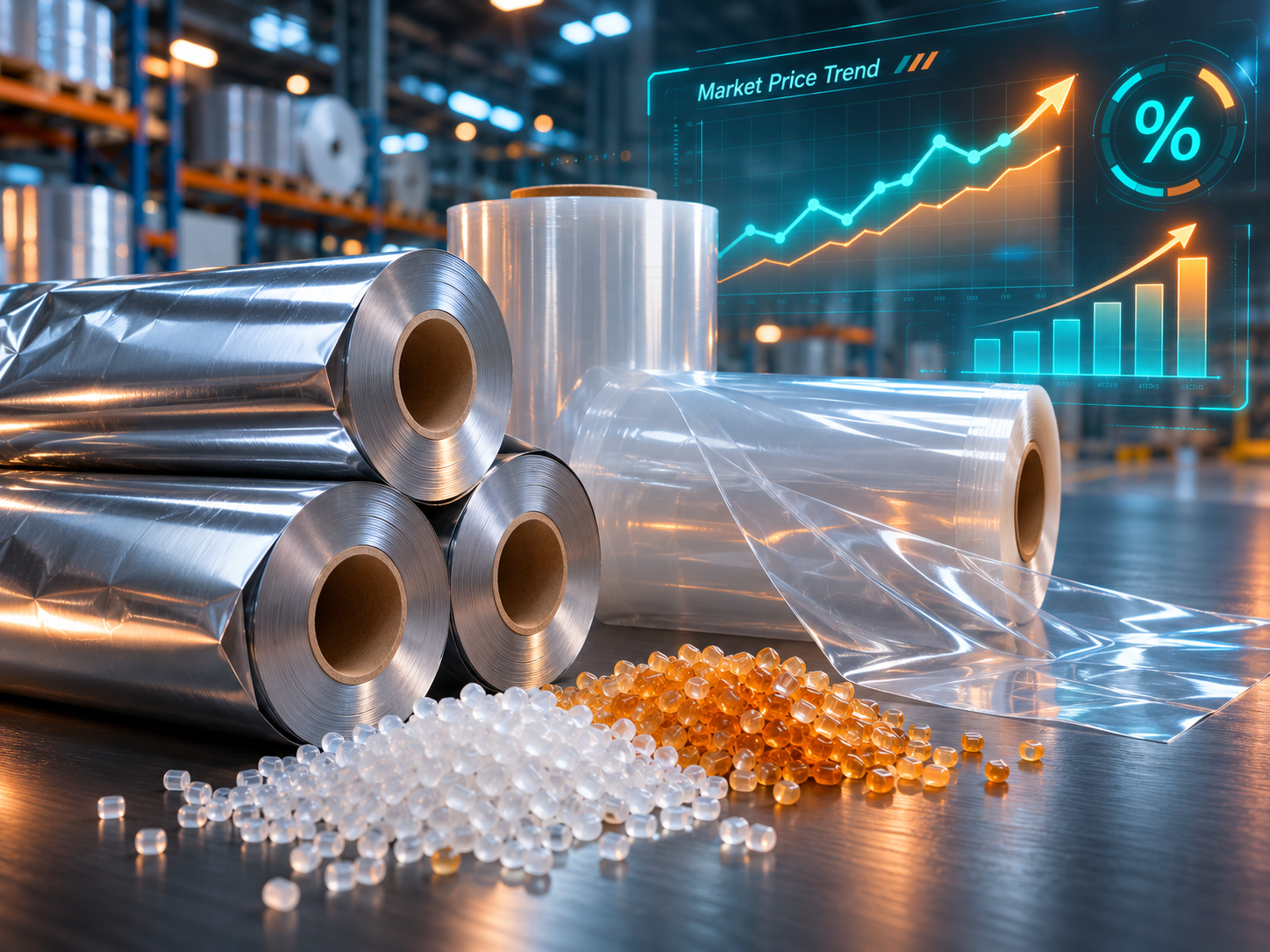
The Current Picture
Raw material costs across the flexible packaging supply chain have been moving unevenly through the second half of 2026. The pressure is not coming from a single source — it is the combined effect of energy costs in Europe, resin supply volatility in Asia, and freight rate instability on major trade lanes.
For buyers planning Q1 2027 orders, the practical question is no longer whether prices will rise, but how much exposure to absorb now versus later.
Which Materials Are Moving
Aluminium foil remains the most volatile input for ABL tube production. Energy-intensive smelting means foil pricing tracks electricity and gas costs closely, and European smelter output has not fully recovered from the capacity reductions of the past two years. Where your tube structure specifies a 7-micron or 9-micron aluminium layer, expect this component to carry the largest share of any cost increase.
PE resins (LDPE, LLDPE, HDPE) have shown moderate but persistent upward movement. PE is used in nearly every laminate structure — as the inner sealant layer, the outer print layer, and the core of all-plastic PBL constructions. A resin increase therefore affects the entire product range, not just one category.
EVOH has been relatively stable compared to aluminium, but supply remains concentrated among a small number of producers. This creates vulnerability: a single plant outage can move prices quickly, and lead times tend to lengthen before prices do.
Adhesives and inks have seen smaller increases, but these are often passed through with less visibility because they represent a smaller percentage of total cost.
What This Means for Your Procurement
Long-term contracts are gaining value.
For buyers with predictable annual volumes, locking price on a 6–12 month agreement transfers volatility risk to the supplier. Suppliers are increasingly willing to offer this — but typically at a premium to spot pricing, because they are absorbing the risk. The question is whether that premium is lower than your expected exposure over the same period.
Structure changes are now a cost lever, not just a technical decision.
Where a product does not require the barrier performance of a full ABL construction, migrating to a PBL or all-plastic structure can reduce exposure to aluminium price movement. This is not a universal recommendation — barrier requirements must still be met — but it is worth reviewing your range to identify where the specification may be higher than the product actually requires.
Order timing matters more than usual.
Q1 is traditionally a strong production period following Chinese New Year, when factories ramp up after the holiday shutdown. Combined with current material movement, placing Q1 orders in December rather than January gives you better scheduling position and reduces the risk of being pushed behind larger accounts.
How Us Managing This
We hold buffer stock on high-turnover structures and pass through material costs on a quarterly review basis rather than order-by-order. This gives buyers predictability within a quarter while allowing us to remain responsive to genuine market movement.
Where a customer has a defined annual volume, we can quote on a fixed-price basis for the contract period. This requires commitment on volume and schedule, but removes material volatility from your cost planning.
What We Recommend Right Now
If you are planning 2027 volumes, the most useful step is to share your forecast now. We can then confirm current pricing validity, identify which of your structures carry the highest material exposure, and advise where a specification review might reduce cost without compromising performance.
For buyers who need pricing certainty beyond the current quarter, a fixed-price agreement is available on defined annual volumes.
Related Reading
[Printing Process Selection Guide for Laminate Tubes and Pouches] — how print method affects cost at different volumes
[ABL Laminated Tubes: The Complete B2B Selection Guide (2026)] — structure comparison and barrier performance
[How Much Do Pactek Laminate Tubes Cost?] — pricing factors and MOQ
Send us your 2027 volume forecast.
We will confirm pricing validity, flag which structures carry the highest material exposure, and quote a fixed-price option if your volumes support it.
Can't find what you're looking for ?
Leave a Message we will call you back quickly!
Product Classification
Professional Service
Interested? Leave your contact details.
Search Starts Here