
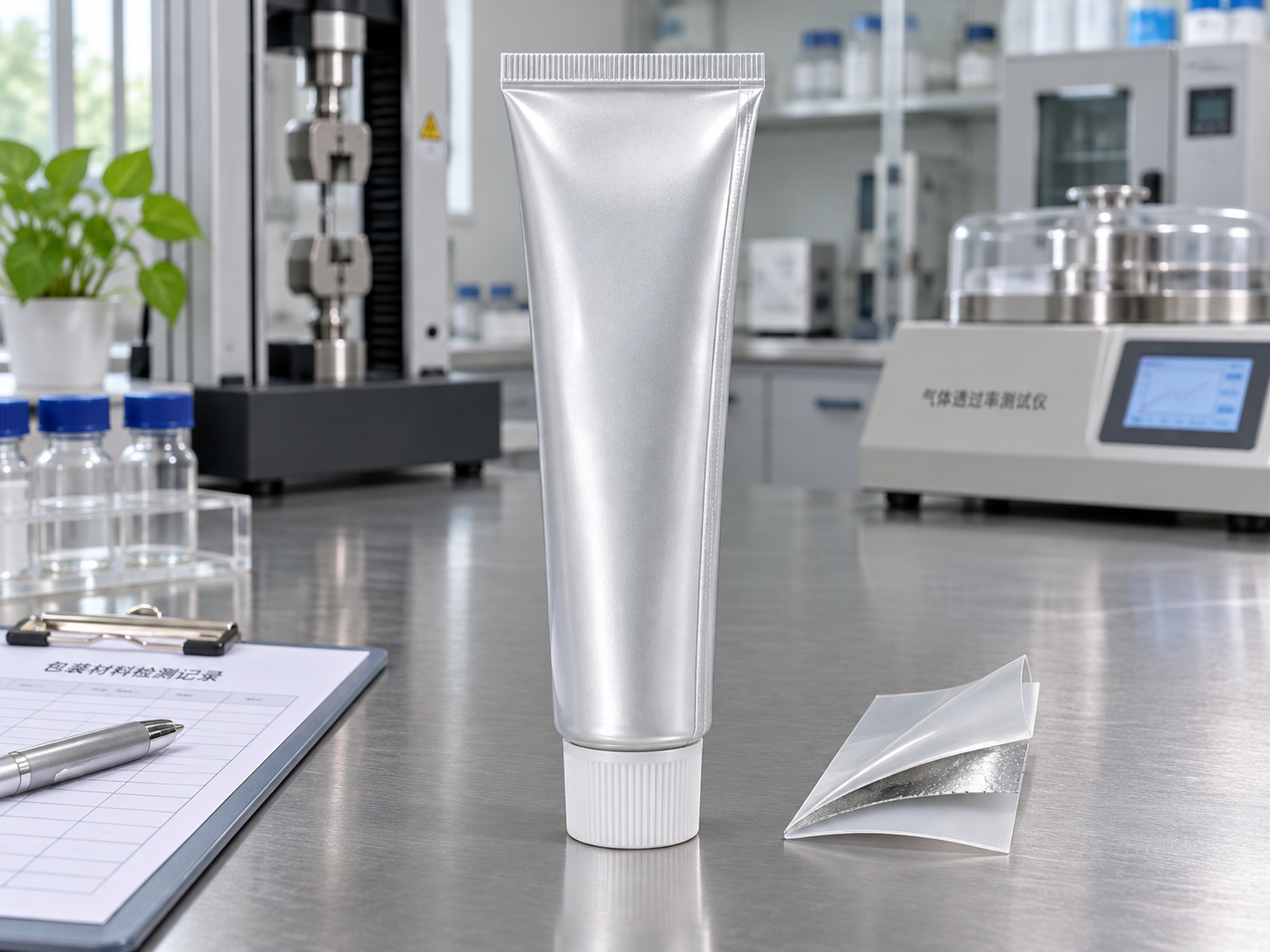
How well can a tube protect its contents from oxygen, moisture, light, and contamination? Understanding ABL tube barrier properties is essential when selecting packaging for products that need to maintain their quality throughout storage and use. Aluminum barrier laminate (ABL) tubes combine plastic layers with an aluminum layer to help shield sensitive formulations from external factors. The laminate, however, is only one part of the package: seams, closures, filling conditions, and the formulation itself also influence protection.
What the aluminum layer actually protects against
An ABL tube is made from a multilayer laminate containing aluminum foil and polymer layers. The exact construction varies, but the foil is generally positioned between plastic layers rather than exposed directly to the product. The plastics contribute functions such as heat sealing, product contact, printability, and mechanical protection, while the aluminum supplies much of the barrier against gases, moisture, and light.
For a formulation that can oxidize, restricting oxygen transmission may help limit changes in color, odor, or performance. A moisture-sensitive product may need protection against water vapor entering the pack; a water-based formulation may also need to limit moisture loss. Aluminum foil can address both concerns when it is continuous and properly incorporated into the laminate.
The same foil layer blocks light through the tube wall. This can be valuable for ingredients that degrade or discolor when exposed to light during distribution or display. The cap and any other exposed parts of the package still need separate consideration: an opaque tube body does not automatically make every part of the filled pack lightproof.
ABL can also help retain volatile components, such as certain flavors or fragrances. That does not mean every aroma is protected equally. Some ingredients can migrate into polymer layers or interact with the product-contact surface, so the behavior of the actual formulation matters as much as the general reputation of the material.
A strong laminate is not the same as a tight package
In procurement discussions, oxygen transmission rate and water vapor transmission rate are often requested for the laminate. These values are useful, but they describe the material under specified test conditions. They do not necessarily predict the performance of a finished tube after forming, filling, sealing, shipping, and repeated consumer use.
A tube has several areas where its protection can differ from that of a flat laminate:
- Side seam: The laminate must be joined consistently during tube forming. A weak or uneven seam can create a route for leakage.
- Shoulder and neck: The joint between the body and shoulder, along with the neck construction, needs to remain intact under handling and squeezing.
- Tail seal: The filled tube is typically sealed at the tail. Product trapped in the seal area or unsuitable sealing conditions can compromise integrity.
- Closure: Cap design, liner or seal choices, and closing consistency affect protection at the opening, particularly after the consumer begins using the product.
This is why a buyer should ask for both laminate data and finished-pack testing. If a supplier provides an excellent barrier figure for the web but cannot explain how the finished tube is checked for seal integrity, the assessment is incomplete.
How much contamination protection can a tube provide?
A properly manufactured and sealed ABL tube can help protect a product from contact with the external environment before opening. Some designs include an additional seal at the dispensing opening, depending on product requirements and filling arrangements. The presence, material, and function of that seal should be confirmed rather than assumed.
After opening, protection changes. A tube is generally squeezed to dispense its contents, which can reduce the need to put fingers directly into the bulk product. Nevertheless, the nozzle can contact hands or other surfaces, and air can enter depending on the tube, closure, and way the product is used. An ABL tube should not be described as sterile, airtight throughout use, or capable of preventing microbial growth solely because it contains aluminum.
The required level of contamination control depends on the formulation and intended use. Preservation, filling hygiene, closure design, and in-use testing may all be relevant. For a pharmaceutical or other sensitive application, the manufacturer should establish the appropriate requirements for the product and its destination markets.
Where the barrier makes a practical difference
Toothpaste is a familiar application for ABL tubes. The package must retain a usable consistency and protect flavor while surviving repeated squeezing in a bathroom environment. Here, barrier performance is only part of the decision: the product-contact layer, closure, appearance, and behavior on the filling line also matter.
For creams, ointments, and other topical formulations, the concerns may include oxygen exposure, moisture exchange, or interactions between the formulation and the inner polymer. A product with sensitive ingredients may justify closer attention to the entire closure system and the conditions used in stability testing. For cosmetics, color or fragrance changes may be commercially important even when the product remains physically intact.
Food products packed in tubes can present different questions. A concentrated condiment or paste may need flavor retention and a suitable food-contact surface, as well as a closure that performs when the tube is stored in a refrigerator or handled at a table. General industrial products can be more demanding still: solvents or other aggressive components may challenge the inner layer, seals, or closure. “High barrier” does not establish chemical compatibility.
ABL versus other tube structures
ABL is often considered alongside plastic barrier laminate, commonly called PBL, and extruded plastic tubes. PBL structures use plastic-based barrier layers rather than an aluminum foil layer, while extruded tubes can be made in different constructions, including multilayer versions. Their actual performance depends on the specified materials and design; the category name alone is not enough to compare two samples.
ABL is worth examining when a formulation needs substantial protection from oxygen, moisture, or light. It can also retain a folded appearance after squeezing, which some brands prefer and others do not. Plastic-based alternatives may offer different visual and handling characteristics, but any barrier comparison should use comparable test conditions and finished-pack designs.
End-of-life considerations can influence the choice. Because ABL combines aluminum and plastics in a bonded structure, recyclability depends on the collection and processing systems available in the destination market. A plastic-based alternative should not automatically be labeled recyclable either: its full construction, closures, local infrastructure, and applicable claim requirements need review.
Which specifications should buyers request?
Start with the product’s vulnerabilities rather than a generic request for the strongest barrier. Identify whether the main concern is oxidation, water loss, moisture uptake, light exposure, aroma loss, or contamination during use. The answer helps determine which measurements and package features deserve the most attention.
For a meaningful comparison, ask prospective suppliers to describe:
- Laminate construction: The product-contact material, aluminum and polymer layers, and relevant thickness information for the proposed structure.
- Barrier test data: Oxygen and water vapor transmission results, where available, with the test method, temperature, humidity, and sample construction. Values measured under different conditions should not be compared as if they were equivalent.
- Tube and closure details: Body size, shoulder and cap materials, opening orifice, any membrane, and the intended tail-sealing arrangement.
- Integrity checks: How seams, shoulders, closures, and filled tail seals are evaluated, including any agreed leak or handling tests.
- Contact and compliance documentation: Information appropriate to the formulation, application, and destination market, supported by the relevant supplier documentation.
Also ask whether the quoted construction is the one used in the supplied test report. A change in laminate, shoulder, cap, or seal can alter the basis for the comparison. If the project moves from a sample to a production order, confirm how material changes will be communicated and approved.
Test the formulation in the finished tube
A specification sheet narrows the options; it does not replace a compatibility study. Fill representative tubes with the actual formulation and assess them under a protocol suited to the product. Depending on the risk, that may include checks for appearance, odor, viscosity, weight change, seal integrity, and relevant ingredient stability over time.
The packaging itself deserves inspection. Look for swelling, leakage, delamination, corrosion-related changes, stress around the shoulder, and difficulty dispensing. Evaluate the cap and nozzle after repeated opening and closing, not just immediately after filling. Distribution conditions and the expected storage environment should inform the study design.
Line trials are equally useful. A tube that performs well in a laboratory can still cause problems if tail-sealing settings, filling temperature, product stringing, or closure handling are not suited to the production process. Agreeing on acceptance criteria before the trial makes the results easier to interpret.
Shanghai Pactek Industries Co., Ltd. works with laminate materials and tube packaging across applications including oral care, cosmetics, pharmaceuticals, food, and industrial supplies. When comparing options through a packaging partner or supplier network, the useful next step is to share the formulation’s known sensitivities, target markets, filling conditions, and expected shelf life. Those details make it possible to discuss a specific laminate and finished-pack validation plan rather than rely on the broad label “ABL.”
Can't find what you're looking for ?
Leave a Message we will call you back quickly!
Product Classification
Professional Service
Interested? Leave your contact details.
Search Starts Here