
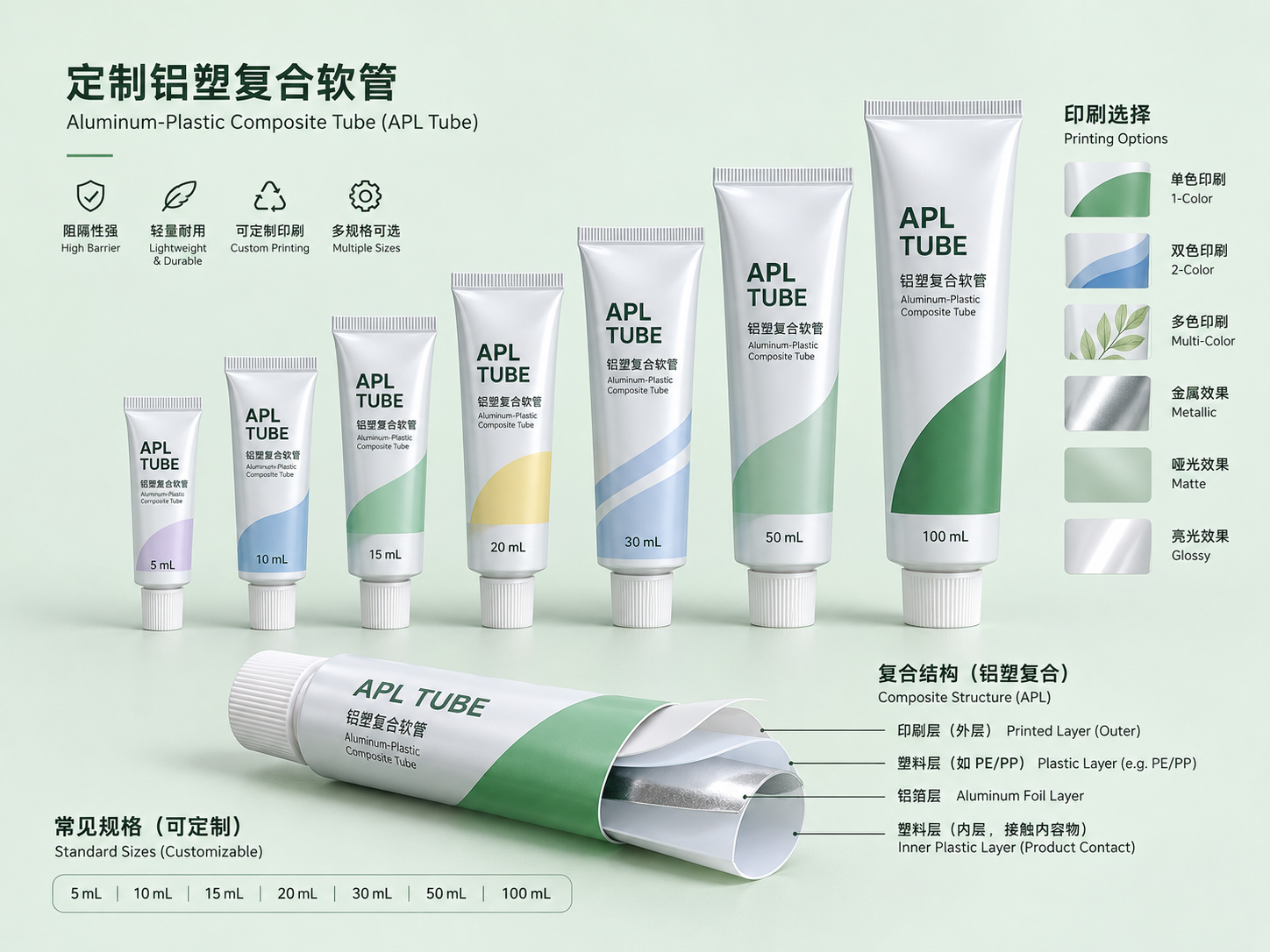
The minimum order quantity (MOQ) for custom ABL tubes depends on the tube size, laminate structure, artwork, printing requirements, and production process. There is no single minimum that applies to every supplier or every design. A relatively standard tube with limited customization may be available in a smaller run than a tube requiring a special laminate, custom tooling, or complex decoration.
For brands comparing ABL vs PBL tube cost, MOQ is part of the packaging budget—not merely a purchasing condition. A lower price per tube may require a larger order, while a smaller run can reduce inventory exposure but carry higher setup costs per unit. Understanding that trade-off makes it easier to request a useful quotation and avoid buying more packaging than a product needs.
What determines the MOQ for a custom ABL tube?
ABL stands for aluminum barrier laminate. An ABL tube is made from a multilayer material that includes an aluminum barrier layer, combined with plastic layers that support forming, sealing, and product compatibility. It is commonly considered for oral care, pharmaceutical, cosmetic, and other products where barrier performance matters.
The MOQ is the smallest quantity a supplier is prepared to produce or supply under an agreed specification. For a custom tube, that specification can involve several separate production stages: preparing the laminate, printing the artwork, forming the tube, fitting the shoulder and cap, and inspecting the finished packaging. A constraint at any one stage can establish the minimum for the entire order.
Suppliers calculate these limits differently. One may have access to a standard laminate and existing components that make a shorter run practical. Another may need to schedule a dedicated material or printing run. The most reliable answer is therefore a quotation based on your actual requirements, rather than a generic MOQ found online.
Tube dimensions and components
Diameter, length, shoulder design, and cap selection all affect production planning. If the requested dimensions and closure are already part of a supplier’s regular range, there may be more flexibility. An unusual diameter, a specially shaped shoulder, or a custom cap can introduce tooling requirements or minimum component orders.
Tube capacity also needs careful interpretation. A nominal volume is a starting point, not a substitute for testing the product in the proposed tube. Formula density, filling conditions, headspace, and the desired finished appearance can all influence the dimensions selected.
Artwork and printing
Custom artwork adds preparation and setup work. Depending on the printing method, the supplier may need plates, cylinders, color matching, or press adjustments before saleable tubes can be produced. More colors, demanding registration, special finishes, and version changes can increase setup time or waste.
Ask whether the MOQ applies to the total tube order or to each printed design. A brand ordering several fragrances may discover that each artwork version has its own minimum. Sharing a common design and differentiating variants through an approved label or secondary package may be worth discussing, provided it suits the product and labeling requirements.
Laminate and barrier requirements
Not all ABL laminates are interchangeable. Layer structure, thickness, surface treatment, and the product-contact layer should be assessed against the formula, manufacturing process, and intended shelf life. A standard structure may be easier to source in a modest quantity; a tailored laminate may involve a separate material minimum.
For pharmaceuticals, food, and other sensitive applications, do not reduce the specification simply to reach a lower MOQ. The supplier and the brand should establish which documentation, compatibility work, and applicable regulatory requirements are needed for the intended market.
ABL vs PBL tube cost: why the comparison starts with the specification
PBL, or plastic barrier laminate, uses a plastic-based barrier structure rather than the aluminum layer found in ABL. The two formats can serve some of the same markets, but they should not be treated as direct substitutes without checking the product’s needs. Barrier performance depends on the complete laminate construction, not just the ABL or PBL label.
Neither material is automatically cheaper for every project. Material structure, tube dimensions, decoration, closure, order volume, and supplier production routes all influence the quotation. A PBL tube could be competitive in one specification, while an ABL option could be more practical in another. The decision becomes clearer when both quotes cover comparable functional requirements and the same commercial terms.
Also ask for the seam, finish, and print appearance to be reviewed on physical samples where possible. A lower quoted price is less useful if the finished tube does not meet the brand’s presentation or filling-line requirements.
How order volume changes the real cost per tube
A custom run usually includes costs that do not rise in direct proportion to the number of tubes ordered. Artwork preparation, press setup, tooling, and production changeovers may still be needed for a small order. When those costs are spread across fewer units, the effective cost per tube rises.
A simple way to compare options is to add the quoted tube value and one-time project charges, then divide by the number of usable tubes expected. For a fuller procurement estimate, include freight, duties where applicable, storage, and the potential cost of obsolete stock. Keep one-time charges separate when comparing a first order with repeat orders; a reorder may not require every initial setup expense again.
Consider a brand choosing between a smaller launch quantity and a larger run with a lower unit price. The larger run may look attractive on the quotation, but it also ties up cash and leaves more printed packaging in storage. If the formula, claims, or design change before that stock is used, the apparent saving can disappear. The right volume balances production economics with a realistic sales forecast.
Can you order fewer tubes than the quoted MOQ?
Sometimes, but a lower minimum usually requires a change in scope rather than a simple price negotiation. Start by asking the supplier which part of the specification sets the limit. If the constraint is a custom cap, for example, changing the artwork will not necessarily solve it.
- Use existing dimensions and components. A standard diameter, shoulder, and cap may avoid a separate tooling or component run.
- Simplify decoration. Fewer colors or a less complex finish may make production planning easier, depending on the printing process.
- Review the laminate specification. A suitable existing structure may be available, but only if it meets the product’s technical and regulatory needs.
- Consolidate artwork where appropriate. A shared tube design can reduce the number of separate versions, although labeling and traceability must remain correct.
- Discuss staged deliveries. A supplier may agree to produce a full run and release it in batches. This does not necessarily reduce the production MOQ, and storage charges or ownership terms should be agreed in advance.
For early development, ask whether samples or a trial arrangement are available. Sample availability is not the same as commercial production capability, however. Confirm which features the samples represent: a stock tube may be useful for a filling trial while not demonstrating the final laminate, print, or closure.
Questions to ask before accepting a quotation
A useful quotation should make the minimum clear enough to plan around. Before placing an order, discuss the following points with the supplier:
- What exactly does the MOQ cover? Confirm whether it applies per tube size, laminate structure, artwork, color, cap, or individual stock-keeping unit.
- Which charges are separate? Ask about artwork preparation, printing plates or cylinders, tooling, sampling, and freight. Clarify whether these charges recur on repeat orders.
- What quantity will be delivered? Check the agreed quantity tolerance and how any overproduction or shortfall will be handled.
- What is the lead time based on? Establish when timing starts, such as after artwork approval, sample approval, or payment, and whether component availability could affect it.
- How will the tube be qualified? Discuss product compatibility, filling and sealing trials, appearance standards, and any required documents before committing to production.
- What happens on a reorder? Confirm whether specifications and artwork assets can be reused, how long they are retained, and whether the same minimum is expected to apply.
These details are especially important when several departments are involved. Procurement may focus on unit cost, while quality teams need material information and production teams need confidence that the tube will run correctly. Aligning those requirements before approving artwork can prevent expensive revisions later.
Planning a practical first order
Bring a forecast, not just a target MOQ, to the conversation. Share the intended product category, approximate annual demand, preferred launch quantity, target markets, tube capacity, closure preference, and decoration requirements. If the formulation is still changing, tell the supplier; the packaging specification may need to remain open until compatibility has been assessed.
Shanghai Pactek Industries Co., Ltd. supplies laminate packaging solutions through a network of manufacturing partners in China. For a custom ABL tube inquiry, sharing the intended application and specifications allows the discussion to move beyond a generic minimum and toward the available material, component, printing, and quantity options. Where appropriate, a PBL alternative can also be reviewed against the same functional and commercial requirements.
The most useful MOQ is not simply the smallest number a supplier will accept. It is the quantity that supports a suitable tube specification, a manageable inventory position, and a cost structure your product can sustain. Ask for the limits behind the quotation, compare ABL vs PBL tube cost on an equivalent basis, and validate the packaging before committing to a production run.
Can't find what you're looking for ?
Leave a Message we will call you back quickly!
Product Classification
Professional Service
Interested? Leave your contact details.
Search Starts Here