
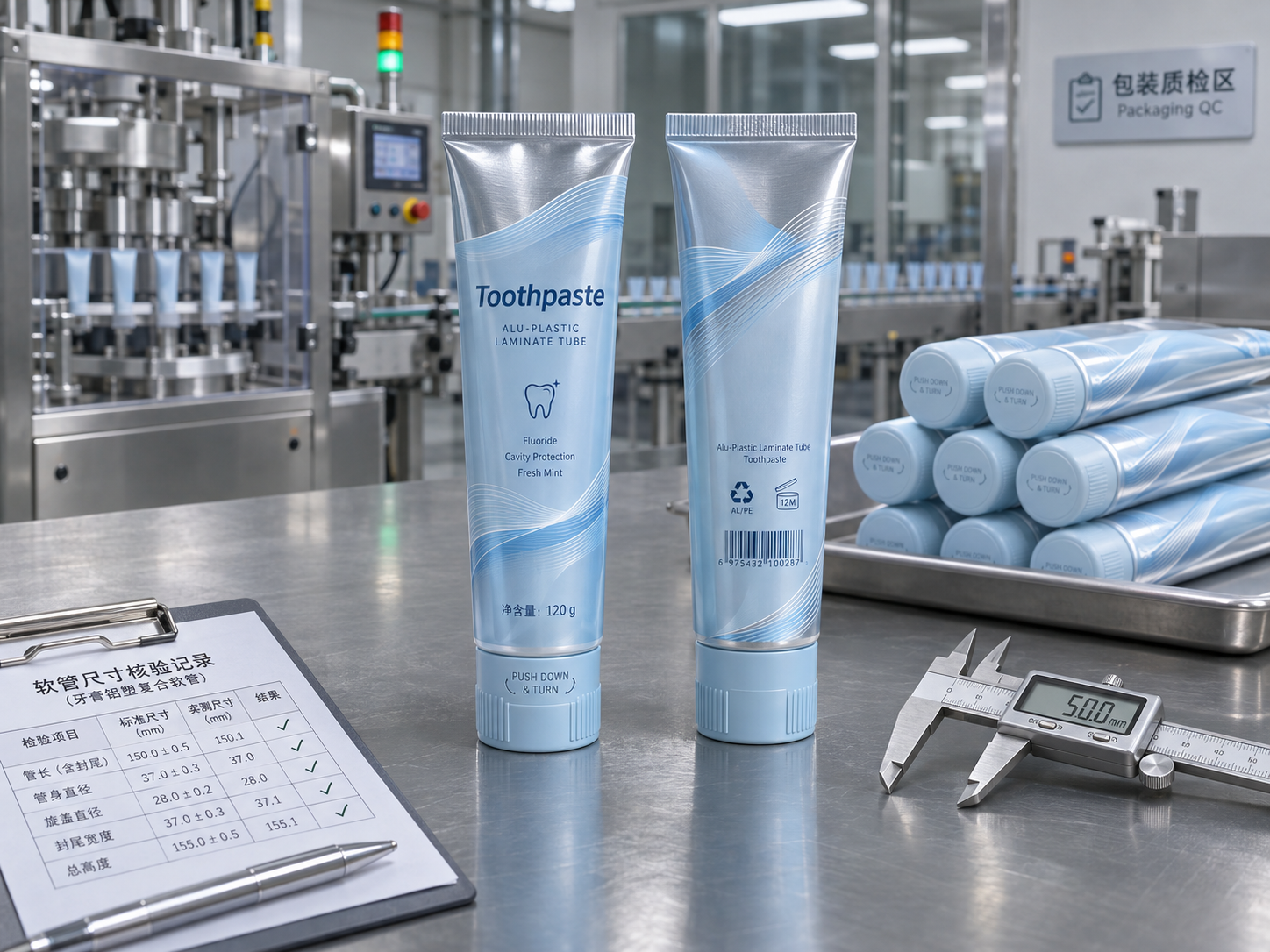
From Our Factory Floor: A Practical Guide for Brand Owners and Procurement Teams
A purchase contract is your only safety net when things go wrong. We’ve seen too many brands sign contracts that simply state "high quality toothpaste tubes," only to find themselves in endless arguments when a batch of tubes fails to seal properly or the aluminum layer corrodes.
When sourcing ABL (Aluminum Barrier Laminate) tubes, vague quality clauses are a recipe for disaster. Based on our years of handling B2B orders, here are the seven critical quality requirements you must write into your contract to protect your interests.
1. The "Golden Sample" Clause (Absolute Priority)
Never accept a contract without a signed sample.
What to specify: The contract must clearly state that mass production must exactly match the approved physical sample (Golden Sample).
Why: Photos and drawings can never capture the exact gloss, feel, and color. The Golden Sample should be kept by both parties and sealed as the only legal reference for disputes.
2. Precise Dimensions and Tolerances
Don't just specify the diameter (e.g., 50mm); you need tolerances.
What to specify: Clearly state the tube's outer diameter, length, wall thickness, and the cap dimensions. Most importantly, establish the acceptable tolerance range (e.g., ±0.2mm).
Why: If the tube is slightly too large, it will jam your filling machines; if it's too small, the cap will leak. Tolerances protect your production line efficiency.
3. Mechanical Performance (Seal & Burst)
This is where ABL tubes frequently fail if the formula isn't compatible.
What to specify: Require Seal Strength (e.g., ≥18 N/15mm via ASTM F88 peel test) and Burst Pressure (e.g., minimum 0.12 MPa for standard tubes).
Why: You must define these physical baselines. If the supplier uses cheap PE resin for the inner layer, the seal will peel open on your customer's shelf.
4. Barrier Material Specifications
ABL's performance comes entirely from the aluminum foil. Don't let suppliers cut corners here.
What to specify: The exact foil thickness (typically 9 µm to 20 µm) and the resin structure (e.g., LDPE / EAA / Aluminum / EAA / LDPE).
Why: A thinner foil might pass the visual check but fail the OTR (Oxygen Transmission Rate) test, causing your sensitive formula to oxidize or lose efficacy months later.
5. Regulatory Compliance & Migration Testing
For toothpaste and pharma, this is non-negotiable.
What to specify: The supplier must provide a Certificate of Analysis (COA) and declare compliance with the target market's standards (e.g., EU 10/2011 for overall migration, or FDA requirements).
Why: If a customs check finds your packaging non-compliant, your whole shipment gets rejected. The contract should mandate the supplier to bear the cost of providing these compliance documents.
6. AQL (Acceptable Quality Limit) Standards
Define what "defective" means and how many you are willing to accept.
What to specify: Adopt a recognized standard like ISO 2859. Clearly define:
Critical Defects (e.g., leakage, chemical contamination): 0% tolerance.
Major Defects (e.g., severe print misalignment, broken caps): e.g., AQL 1.5.
Minor Defects (e.g., slight color variation, minor scratches): e.g., AQL 4.0.
Why: Without AQL, a factory might argue that 5% leakage is "normal." AQL sets a fair, objective standard for batch acceptance or rejection.
7. Printing and Artwork Ownership
Custom branding is the core of your product.
What to specify: Define the color deviation tolerance (e.g., ΔE < 2 based on Pantone), the cylinder/plate costs, and the ownership of the printing plates.
Why: You paid for the artwork and the tooling. The contract should ensure the supplier cannot use your custom plates to produce "knock-off" tubes for others.
Our Bottom Line:
A good contract isn't about distrust; it's about aligning expectations. As a manufacturer, we prefer clients who specify precise standards (like foil thickness and AQL) upfront. It saves us from production nightmares and saves you from marketing disasters.
Can't find what you're looking for ?
Leave a Message we will call you back quickly!
Product Classification
Professional Service
Interested? Leave your contact details.
Search Starts Here